
US 207-200-1920
The Fundamental Advantages of the Turbosawmill Sawmill Design
Open-Side Access
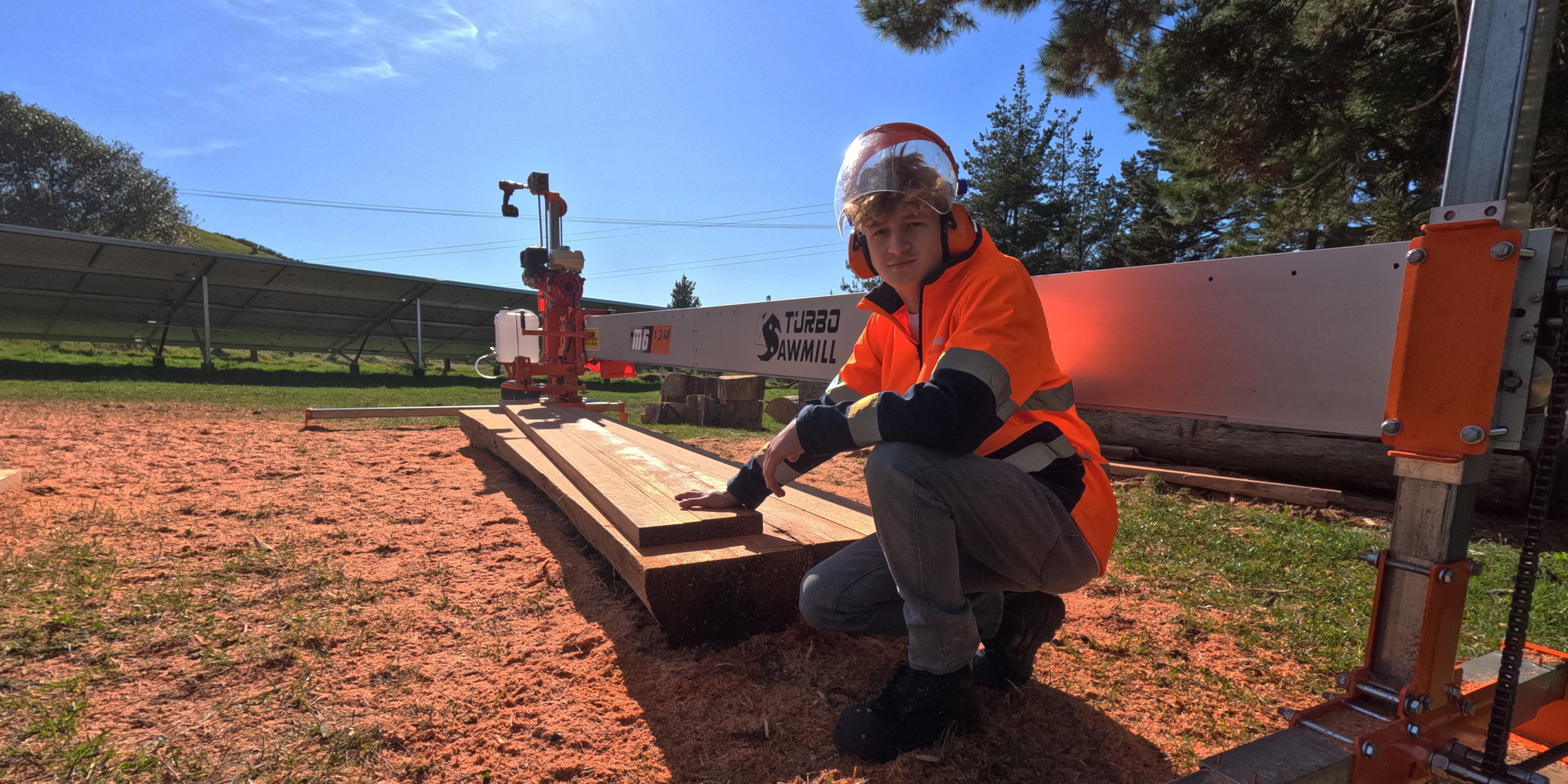
Easy access during timber loading and removal is critical to efficient sawmilling—and this is where Turbosawmill truly stands apart from conventional designs. Every Turbosawmill model is engineered from the ground up with open-side access as a core design principle.
Many traditional sawmill layouts position the cutting head on one side of the log with restricted clearance on the other. This forces operators to extract timber through narrow gaps, often requiring awkward handling or additional mechanisms. Earlier twin-rail and twin-blade sawmill designs commonly relied on drag-back systems, using bars or arms that restricted access and added complexity to timber handling.
Turbosawmill eliminates these limitations with true 180-degree open-side access. This design allows even the largest and heaviest beams to be removed effortlessly. Forklifts or loaders can be positioned directly alongside the log, enabling timber to slide sideways onto forks or support arms—no manual lifting required.
Just as importantly, the blade is positioned safely alongside a single beam and remains over the log and away from the operator, improving both visibility and safety during operation.
In practical terms, open-side access is one of the defining advantages of Turbosawmill. It simplifies timber handling, reduces labour, improves site safety, and significantly increases overall milling efficiency—especially when working with large logs and heavy structural timber.
Easy On-Saw Sharpening and Maintenance
Sharpening the Turbosawmill is fast and simple. A compact sharpening device clips into a hole near the tooth, and a cordless drill spins a diamond stone directly onto the face of the tungsten carbide. The entire process takes under a minute, is highly efficient, and can be done right on the saw—no blade removal required.
Maintaining your blade is very easy. From time to time, it’s possible to burn a blade—this happens if it jams in the cut and you’ll see smoke rising. This is straightforward to fix and simply involves hammering the blade back to straight. For this, you take it to a saw doctor, which is typically a minimal cost.
The teeth are fully removable. We supply a dedicated tool that allows you to clip teeth in and out easily. We use our own locking system, where a grub screw passes through the tooth and locates into a divot in the blade, holding everything securely in place for extra safety.
One-Man Operation Efficiency
The brilliance of the Turbosawmill monorail design is most evident in its exceptional ease of use for single-operator milling. In a true one-person operation, the workflow remains smooth, efficient, and uninterrupted.
When sawing horizontally first, the operator can simply step around the carriage to retrieve timber—no wedging, no climbing, and no walking the length of the sawmill. This stands in sharp contrast to many other sawmill designs, where operators are forced to wedge every beam or repeatedly navigate around the entire mill just to collect boards.
The monorail layout keeps the working area open and accessible, allowing timber to be removed quickly and safely while the next cut is prepared. This reduces unnecessary movement, saves time on every board, and significantly lowers operator fatigue over the course of a day.
This is the monorail difference—a design philosophy focused on real-world efficiency, safer handling, and true single-operator productivity. With Turbosawmill, one person can mill confidently, comfortably, and efficiently without compromise.
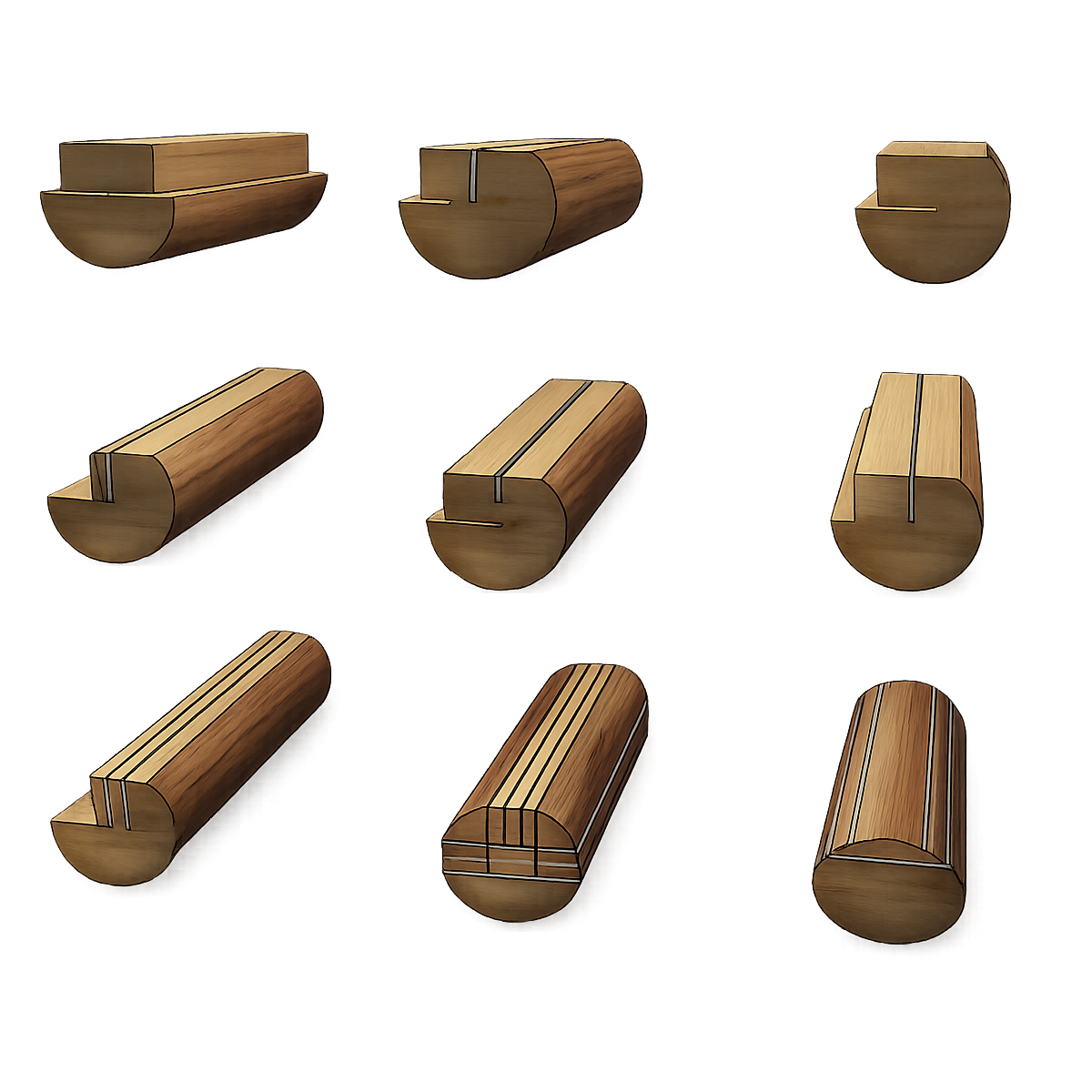
Quarter Sawing & Flat Sawing
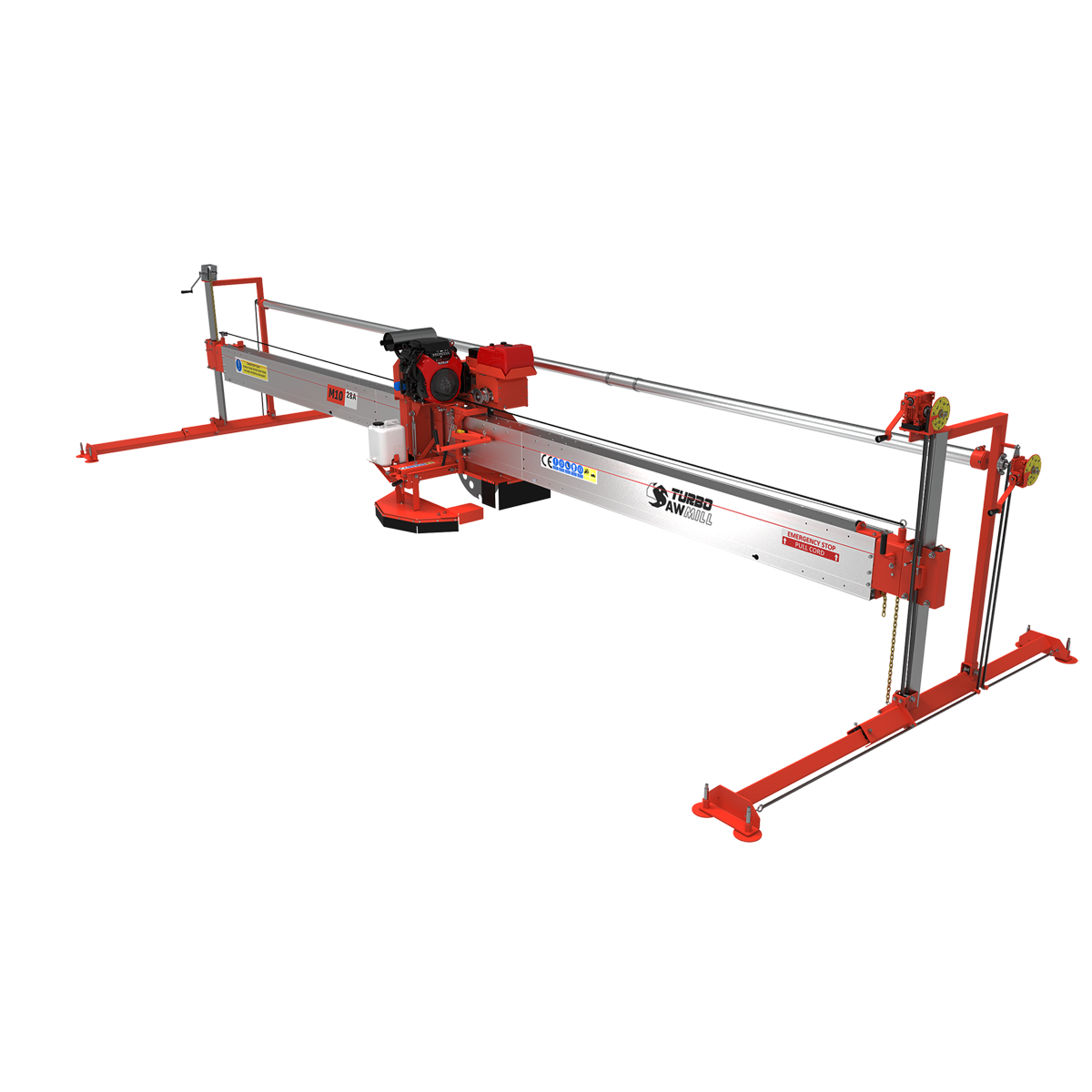
One of the key advantages of a swing-blade sawmill is the ability to quarter saw and flat saw without rotating the log. Using a single blade that swings between horizontal and vertical cutting positions, Turbosawmill allows you to process timber efficiently while keeping the log stable and in its natural orientation.
With quarter sawing, boards are cut vertically toward and around the heart of the log. Turbosawmill makes this process effortless, delivering consistent grain structure and high-quality structural timber without the need for log rotation or repositioning. This approach clearly sets the swing-blade apart from many twin-blade designs, which often rely on a large vertical blade paired with a smaller horizontal blade—limiting cutting depth, flexibility, and board size options.
This same versatility extends to flat sawing (also known as back sawing). Flat-sawn boards are removed horizontally from the top, bottom, and sides of the log rather than vertically. This method is especially effective when working with tensioned or stressed logs, as it helps minimise crook and distortion in the finished boards.
At Turbosawmill, you’re not locked into a single cutting method. The swing-blade system gives you the freedom to choose quarter sawing, flat sawing, or a combination of both, allowing you to adapt your cutting strategy to the log, timber species, and final application. The result is greater flexibility, higher recovery, and precision control on every cut.
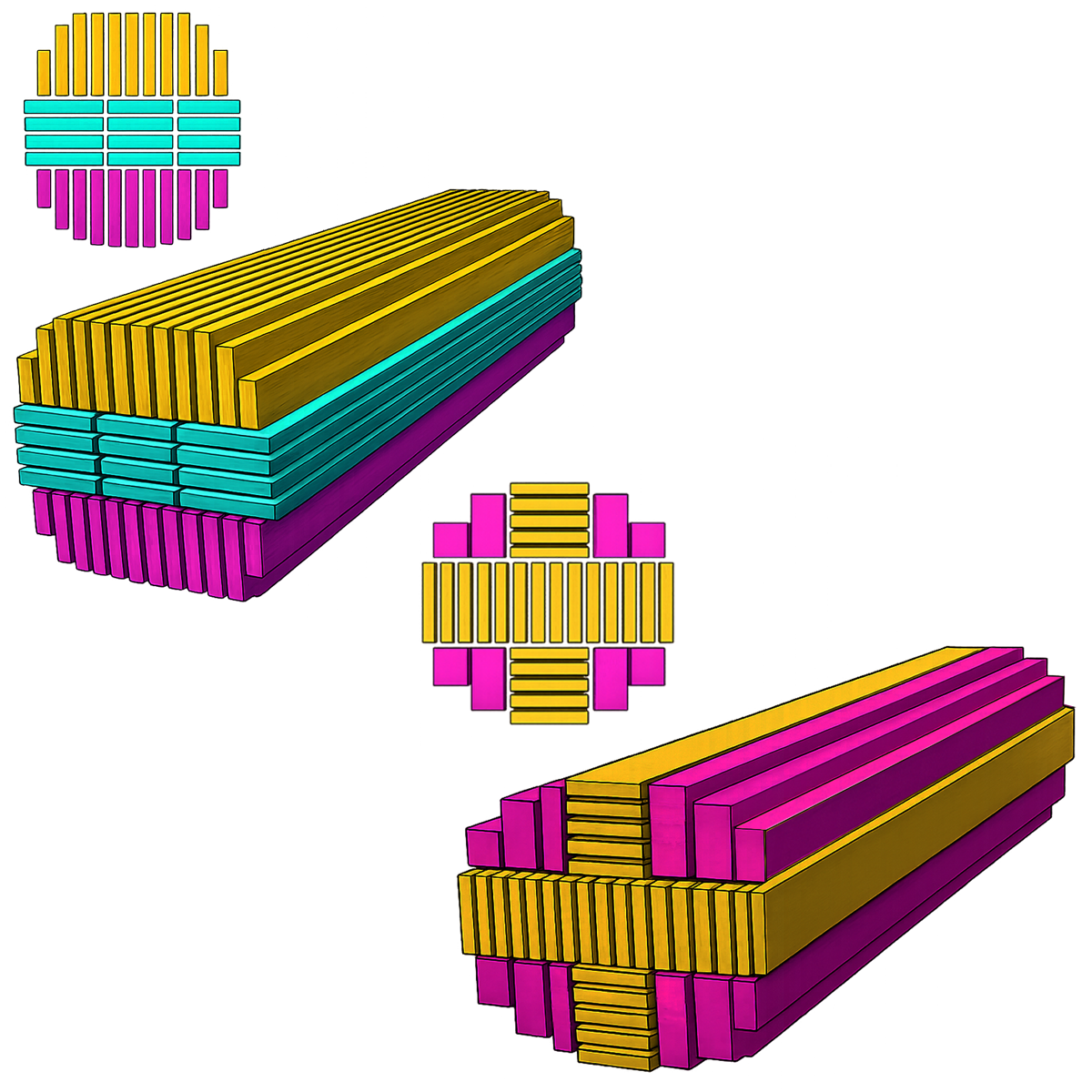
Sectional Cuts
Sectional cutting is one of the most powerful advantages of a swing-blade sawmill, especially when working with hard, dense, or difficult timber. Think of it like using a drop saw on oversized material—controlled, precise, and far easier on both the machine and the blade.
When cutting hardwoods, vibration is often the first sign that cutting forces are rising. On many sawmill designs, this raises concerns about blade stress, accuracy, and long-term wear. The swing-blade eliminates this issue by allowing the operator to break wide boards into multiple sectional cuts, dramatically reducing cutting load and protecting both the saw and blade.
This approach is particularly effective when milling tough species such as oak, ironwood, and other high-density hardwoods, where producing a 12-inch wide board may require two or three sectional passes. Instead of forcing a single heavy cut, the swing-blade lets you work progressively and safely through the timber.
Beyond reducing load, sectional cuts deliver exceptional accuracy. The first cut establishes a clean reference edge, guiding each subsequent pass so the board remains true and consistent from one side to the other. This precision is critical when sawing wide horizontal boards, an area where many twin-blade mills struggle—especially in hard timber.
Turbosawmill takes sectional cutting even further with automated swing-blade systems. Automation removes the need to walk repeatedly up and down the log between cuts, allowing sectional cuts to be completed smoothly, efficiently, and with minimal operator effort.
The result is a sawmilling process that is gentler on equipment, more accurate in hard timber, and far more productive—redefining what’s possible when cutting wide boards with a swing-blade sawmill.
Production Milling
Swing-blade sawmills have long proven their strength in high-production milling, consistently delivering outstanding results in competitive environments such as the Paul Bunyan Shootout, where mills are pushed head-to-head under real production pressure. Dollar for dollar, swing-blades repeatedly outperform alternative sawmill designs—and the reason is efficiency.
Unlike many other mills, a swing-blade gains a major production advantage by allowing the next board to be cut while the previous board is being removed. This overlap in workflow saves approximately 10–20 seconds per board, which quickly compounds into a significant productivity gain over the course of a day.
By comparison, twin-blade mills have historically struggled in true production settings. Even when entered in past competitions, their requirement to cut a board, stop, and then return the head before making the next cut has proven to be a major bottleneck—severely limiting output.
Turbosawmill takes the swing-blade advantage even further with automation. Our automated swing-blade mills allow one operator to achieve production levels that typically require two operators on other swing-blade systems. While the mill automatically cuts the next board, the operator has time to safely collect, stack, and prepare for the following cut—without interrupting the cutting cycle.
The result is a highly efficient, continuous production workflow that maximises output, reduces labour requirements, and delivers exceptional daily volume. In production milling, Turbosawmill sets a new benchmark for speed, efficiency, and operator productivity.
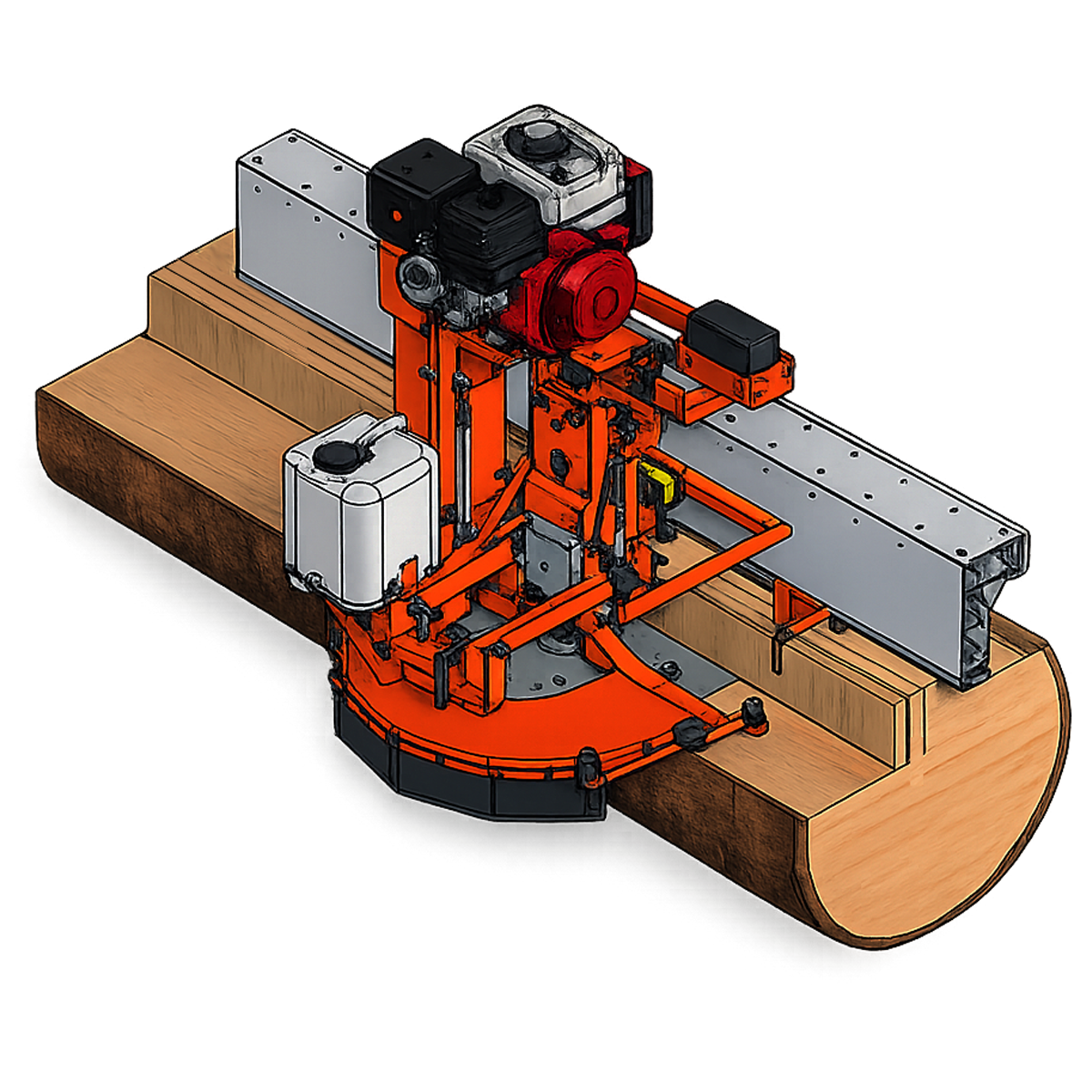
Tension Relief
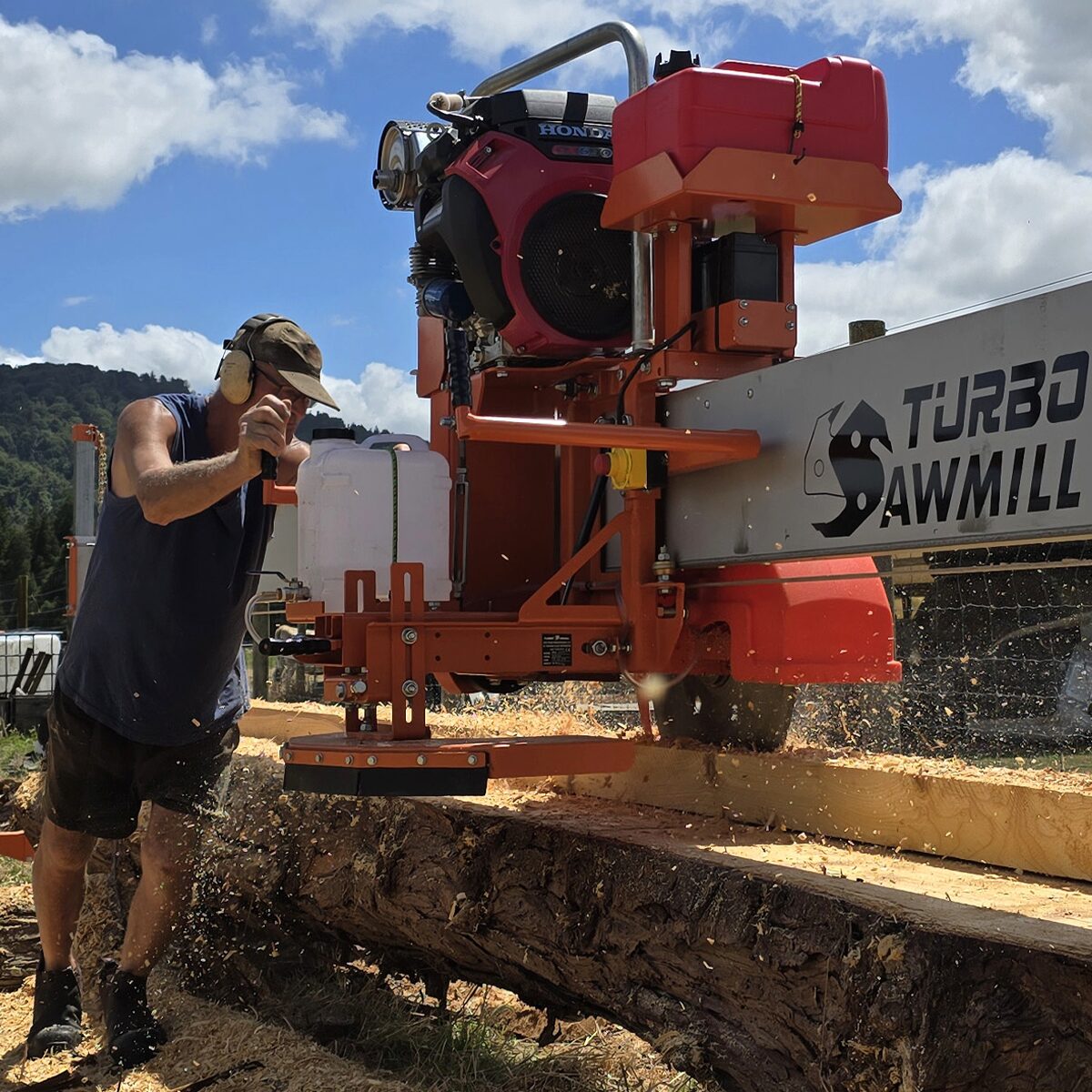
Managing internal log stress is one of the biggest challenges in sawmilling, and it’s an area where the single-blade swing-blade design offers a decisive advantage. Turbosawmill allows you to mill tensioned and stressed logs with far greater control, reducing blade binding and improving cut quality.
With a swing-blade sawmill, you can freely alternate between vertical and horizontal cuts—starting in either direction as the log dictates. This flexibility allows internal stresses to be released gradually, rather than forcing the timber to close back onto the blade, which is a common problem with twin-blade sawmill designs.
If tension begins to show during a cut, the solution is simple: change the cutting pattern. Switching from vertical to horizontal (or vice versa) immediately relieves pressure on the blade, keeping the cut smooth and controlled without stopping or reconfiguring the mill.
This ability to adapt on the fly is one of the key reasons Turbosawmill excels in difficult timber, including stressed hardwoods, plantation-grown logs, and fast-grown species. The result is safer operation, cleaner cuts, reduced blade stress, and a far more efficient milling process—especially when working with unpredictable or tensioned logs.
Double Cutting
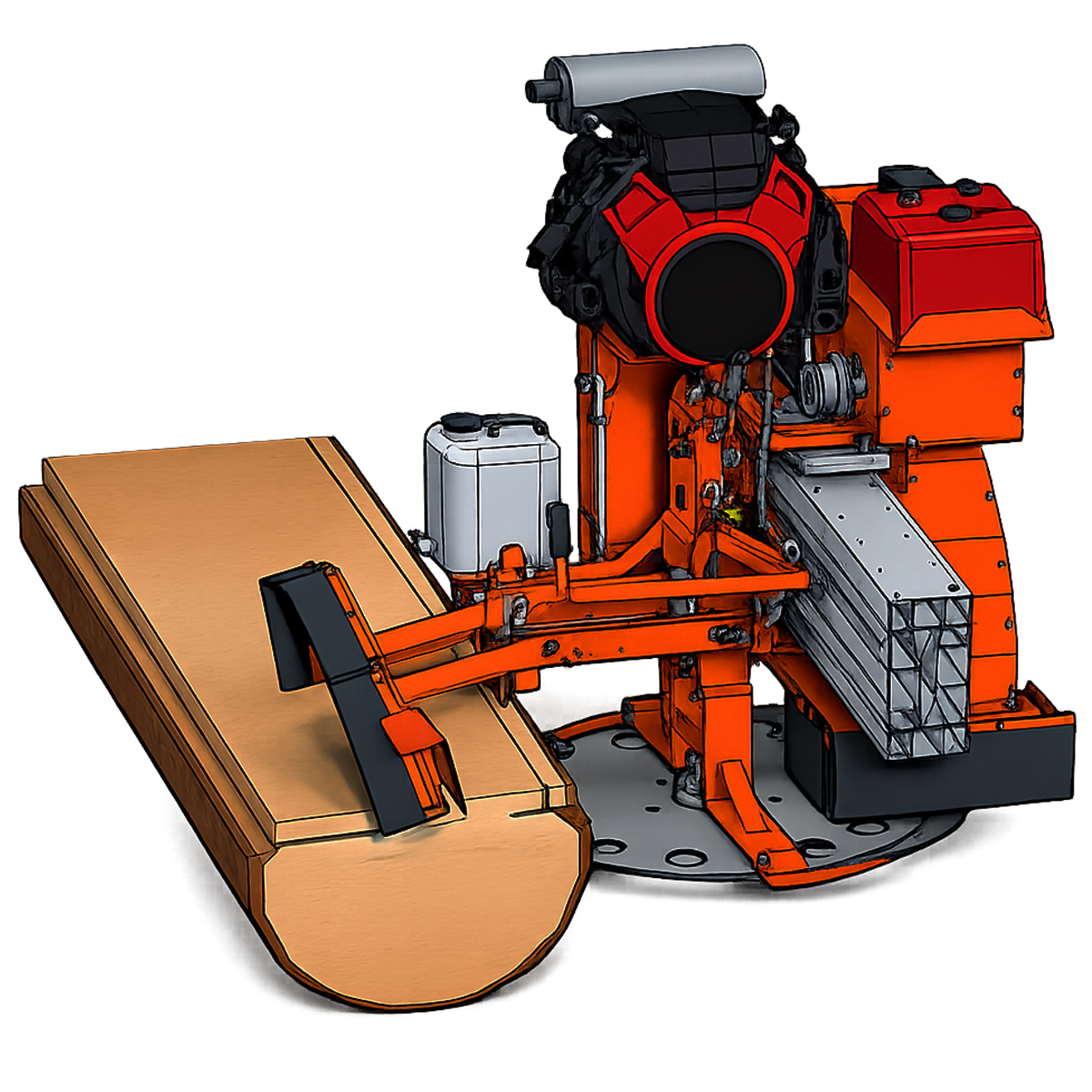
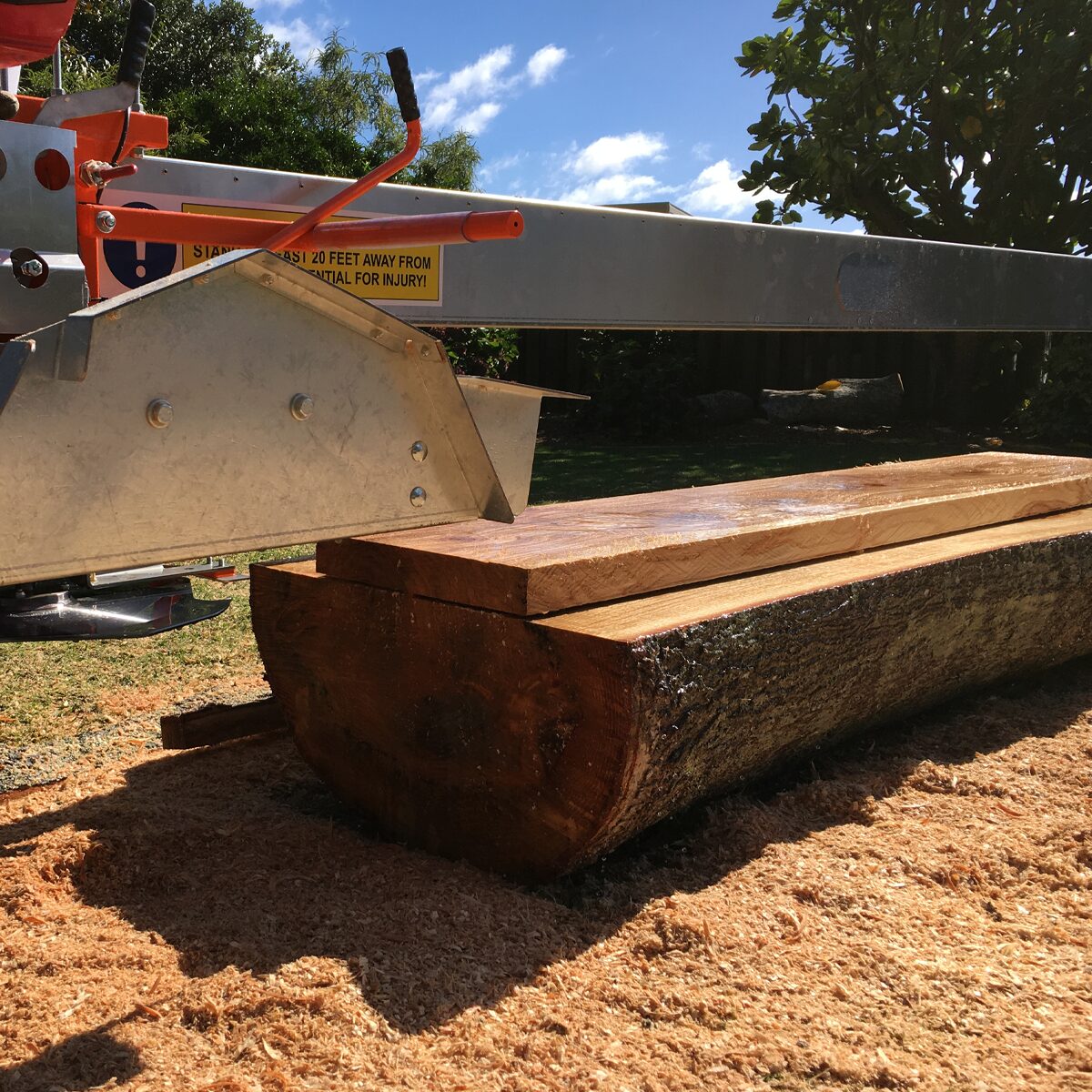
Double cutting is a critical capability when producing wide slabs and large-format timber, and it’s an area where many circular and twin-blade sawmill designs fall short. Traditional twin-blade systems rely on two or more fixed blades, and their limitations become obvious when attempting the second, reverse horizontal cut. In many cases, the power head is positioned beside the blade, physically blocking the cut path and preventing a true, continuous double cut.
Some swing-blade designs claim this capability, but in practice require the carriage to be lifted and rotated, adding time, complexity, and unnecessary handling.
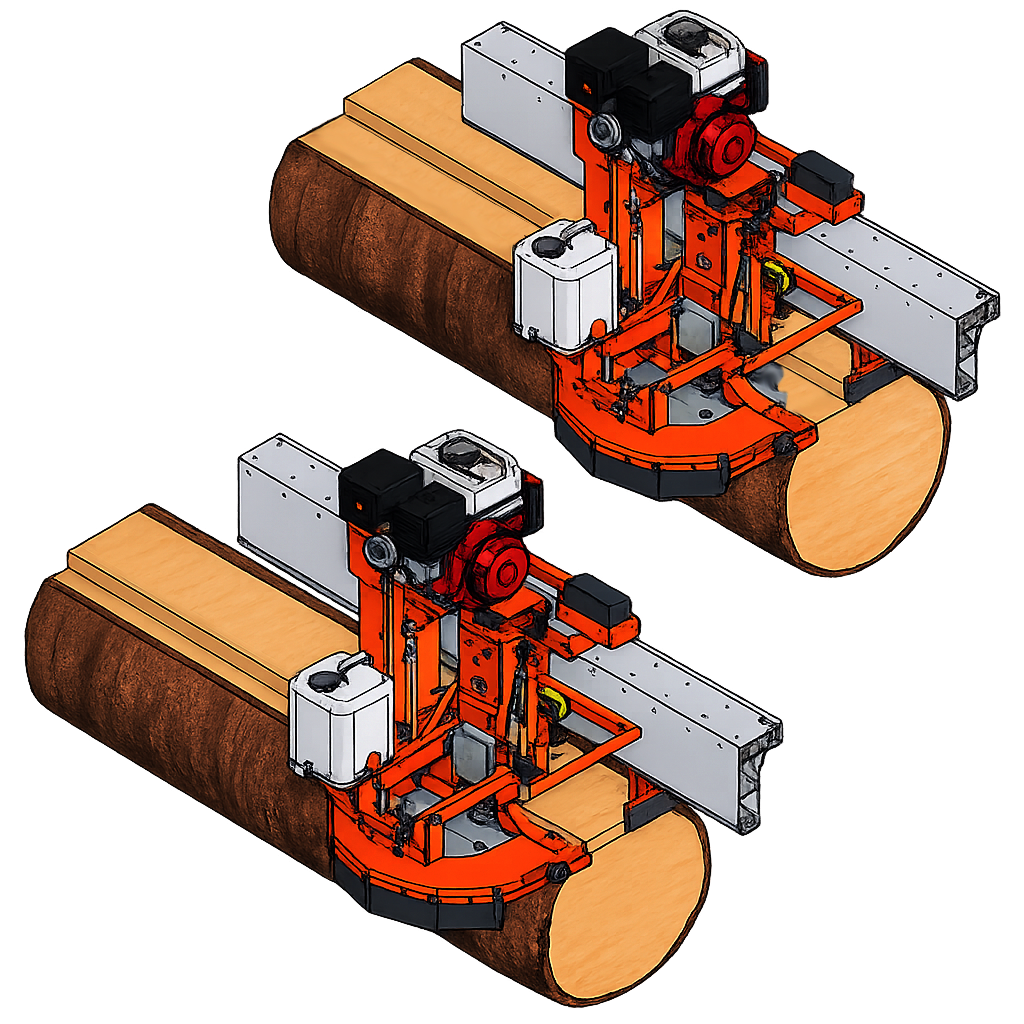
Turbosawmill was engineered specifically to eliminate these constraints. Our swing-blade design features a removable horizontal guard, allowing the blade to cut cleanly in both directions without obstruction. This enables smooth, accurate double cutting without repositioning the carriage or interrupting workflow.
The result is exceptional wide-cut performance. On the Turbosawmill Model 12, double cutting allows operators to produce slabs up to 24 inches wide in a single drop, opening up possibilities for large beams, wide boards, and live-edge slab work.
Double cutting with Turbosawmill is fast, controlled, and repeatable—delivering true wide-cut capability without compromise. It’s another example of how intelligent design translates directly into real-world sawmilling efficiency.
The Turbosawmill can also be fitted with an attachment slabber to cut slabs up to 5ft (1.5m) wide!
Resawing
Resawing is where automated swing-blade sawmills really excel. Waney, bowed, or crooked boards can be efficiently re-sawn—provided they were initially oversized. Side off-cuts generated during resawing are ideal for fillets, making excellent use of what would otherwise be waste timber.
Stack and stage boards close to the mill so they’re ready for resawing when required.
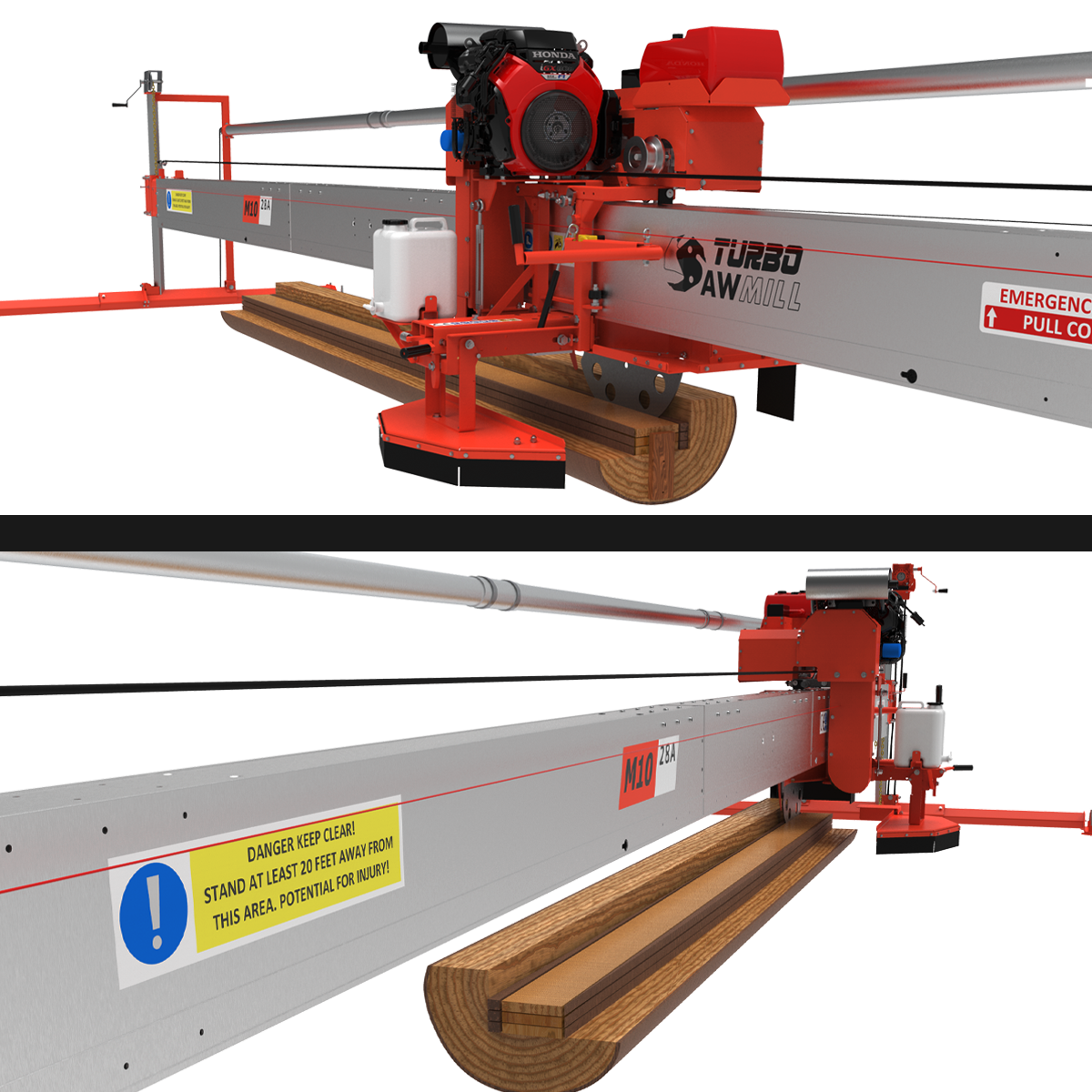
When resawing, leave a half-cut, stable log on the mill with one clean side edge intact, as shown in the diagram. Place the crooked or waney board with its concave face tight against the log’s side edge. With the blade in the vertical position, feed the saw forward, away from the operator, on each side of the board. This controlled forward feed pushes the board into the log face, eliminating movement and producing a perfectly straight-edged result.
For very light timbers, add a simple safety stop at the operator’s end of the log. A small timber lip—approximately 1 inch high—screwed in front of the boards prevents any chance of material ejecting toward the operator.
This resawing method is especially valuable when processing high-stress species such as eucalyptus, where it is often the only practical way to recover straight, high-quality timber from difficult logs.
Swing-Blade vs Bandsaw Sawmills — A Clear Comparison
Swing-blade and bandsaw sawmills differ significantly in how they cut, handle logs, and manage long-term operating costs.
Cut Accuracy
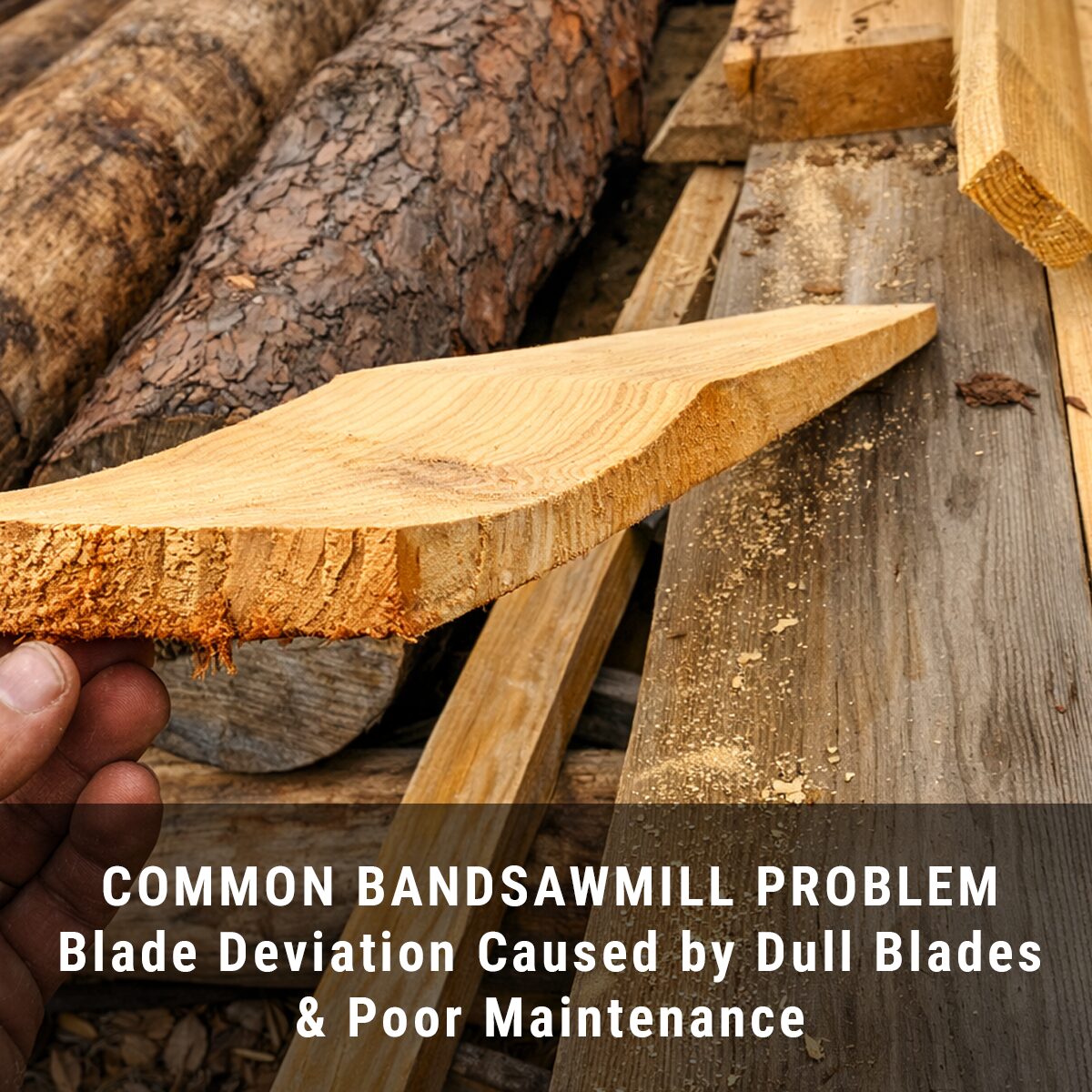
Bandsaw blades can deflect as they dull, which may lead to uneven cuts. Turbosawmill’s circular swing blade maintains straight cutting and gives clear feedback when sharpening is needed.
Workflow & Handling
Bandsaws typically require multiple log rotations and re-edging. Turbosawmill cuts directly through the log without rotation, reducing handling and improving efficiency.
Blade Maintenance
Bandsaw blades require specialised sharpening and frequent replacement. Turbosawmill uses on-site sharpenable teeth with long service life and minimal downtime.
Timber Stress Control
Bandsaw systems often manage log tension through repeated cuts and rotation. Turbosawmill progressively relieves tension as it cuts, producing consistent timber with simpler operation.
Recovery & Waste
Real-world recovery is influenced by handling as much as kerf. Turbosawmill recovers usable timber down to the bark and produces clean shavings instead of fine dust.
Log Size & System Cost
Bandsaws are limited by throat width and often require additional equipment. Turbosawmill handles logs of virtually any diameter as a complete, cost-effective system.
Summary
For operators seeking accuracy, low handling, and efficient recovery, a swing-blade sawmill—particularly Turbosawmill—offers practical advantages in everyday milling.
Comparing Our Manual Push Mills
Lightweight Push–Pull Carriage
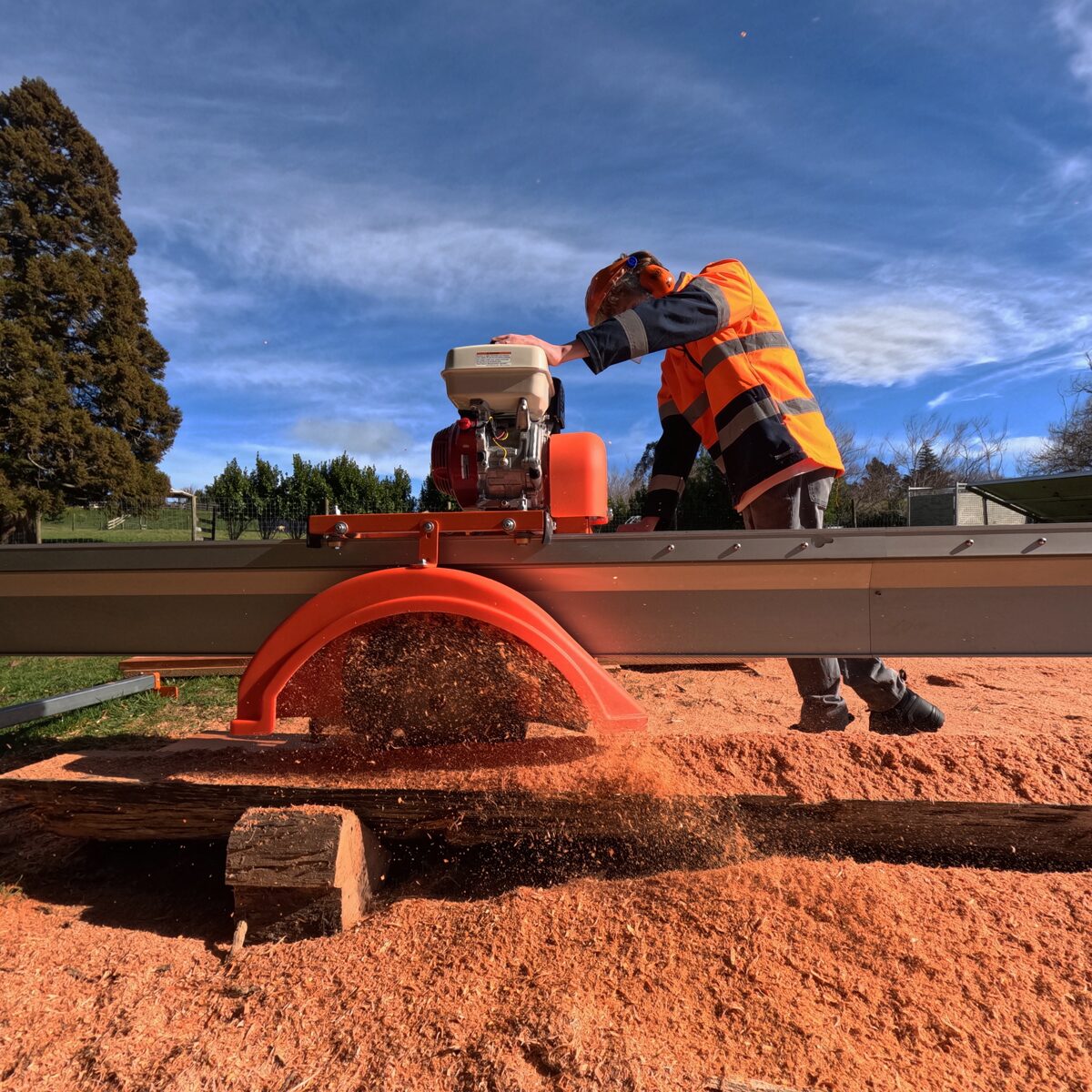
One of the standout advantages of the Turbosawmill manual push mill range is the exceptionally low push–pull weight of the carriage. Because the carriage does not rely on a heavy supporting frame, overall mass is kept to an absolute minimum—reducing operator fatigue and improving daily productivity.
On the M8 manual mill, the carriage weighs just 70 kg (154 lb), and the motor weighs only 37 kg (80 lb). This results in a total push–pull weight of 107 kg (235 lb). By comparison, many competing manual sawmills start at 150 kg (330 lb) or more.
The difference is immediately noticeable in operation. Less weight means smoother control, easier handling, and far more energy left at the end of the day—especially important for single-operator milling.
Minimal Twist in Vertical Cuts
Vertical cut accuracy is critical, and this is another area where Turbosawmill excels. The Turbosawmill carriage is directly coupled to the beam, which keeps blade twist to an absolute minimum during vertical cuts.
Wide frame carriage designs often suffer from twist if the pull arm is not perfectly aligned with the leading edge of the vertical blade. Operators frequently compensate by pulling with both arms to maintain a straight cut—an issue that worsens as carriage rollers wear over time.
Turbosawmill’s monorail beam design avoids this problem entirely. The result is stable, true vertical cuts, reduced operator effort, and consistent accuracy without fighting the machine.
Automated Turbosawmill vs Other Swing-Blade Systems (Australia)
Turbosawmill is designed for high-efficiency, automated swing-blade milling, with a particular focus on simplifying wide horizontal cutting and material handling.
-
Automated horizontal cutting – Wide boards can be produced using a repeatable multi-pass process, with simple lever-based control depending on configuration and setup.
-
Open-side access design – The open working side allows timber and large flitches to be removed directly to a stack or loader, which can be beneficial when handling heavy material.
-
Centralised sizing controls – Sizing adjustments are made from a single operator position, helping improve workflow consistency and ease of use.
-
Large extruded alloy beam design – The beam profile is engineered to provide stiffness and stability across the cutting range.
-
Heavy-duty frame construction – Built with rigidity in mind to support accuracy and long-term durability under production conditions.
-
Double-cut capability – The design allows wide boards to be produced using opposing horizontal passes, without requiring the mill to be repositioned.
-
Stable vertical cutting geometry – The monorail layout is intended to minimise carriage movement during vertical cuts, reducing reliance on operator correction.
-
Industrial gearbox drive system – Uses a high-capacity gearbox designed for continuous production sawing.
-
Optional electronic setworks – Available for users seeking enhanced precision, repeatability, and automated sizing control.
Summary:
Turbosawmill focuses on operator efficiency, flexible cutting methods, and automated workflow, offering a design approach aimed at improving productivity and handling in production swing-blade sawmilling applications.
Automated Turbosawmill vs Other Swing-Blade Systems (New Zealand)
Turbosawmill is designed for high-efficiency, automated swing-blade milling, with a particular focus on simplifying wide horizontal cutting and material handling.
-
Automated horizontal cutting – Wide boards can be produced using a repeatable multi-pass process, with simple lever-based control depending on configuration and setup.
-
Open-side access design – The open working side allows timber and large flitches to be removed directly to a stack or loader, which can be beneficial when handling heavy material.
-
Centralised sizing controls – Sizing adjustments are made from a single operator position, helping improve workflow consistency and ease of use.
-
Large extruded alloy beam design – The beam profile is engineered to provide stiffness and stability across the cutting range.
-
Heavy-duty frame construction – Built with rigidity in mind to support accuracy and long-term durability under production conditions.
-
Double-cut capability – The design allows wide boards to be produced using opposing horizontal passes, without requiring the mill to be repositioned.
-
Stable vertical cutting geometry – The monorail layout is intended to minimise carriage movement during vertical cuts, reducing reliance on operator correction.
-
Industrial gearbox drive system – Uses a high-capacity gearbox designed for continuous production sawing.
-
Optional electronic setworks – Available for users seeking enhanced precision, repeatability, and automated sizing control.
Summary:
Turbosawmill focuses on operator efficiency, flexible cutting methods, and automated workflow, offering a design approach aimed at improving productivity and handling in production swing-blade sawmilling applications.
Turbosawmill Advantage Over Twin-Blade Circular Sawmill Designs
Turbosawmill is engineered around a single-blade, open-access swing-blade architecture that prioritises efficiency, safety, and ease of handling—particularly when working with large logs and wide timber.
Open-side access frame
The open-side layout allows boards and large flitches to be removed directly from the side of the log. Timber can be transferred straight onto a forklift or stacking area without reaching through end frames or confined spaces, improving workflow and safety.
Raised main beam design
With the main beam positioned off the ground, sawdust does not accumulate around critical components, helping maintain consistent operation and reducing clean-up time.
Single-point sizing control
All sizing adjustments are made from one location, simplifying setup, improving accuracy, and speeding up production.
Beam alignment flexibility
The far end of the beam can be adjusted to align precisely with the log’s natural position, improving cut consistency on uneven or tapered logs.
Heavy-duty extruded alloy beam
Turbosawmill uses a large extruded alloy beam designed for stiffness and stability across both vertical and horizontal cuts.
Rigid frame construction
The frame is built for strength and durability, supporting accurate cutting and long-term reliability under demanding conditions.
Industrial gearbox drive
Power is delivered through an industrial-grade gearbox, designed for continuous high-load cutting.
Single-blade cutting efficiency
By concentrating power through a single blade, Turbosawmill enables wide cuts through controlled double-cutting while maintaining cutting efficiency.
Natural stress relief during cutting
Cutting one edge at a time allows timber stress to be released progressively, helping maintain board quality.
Sectional cutting capability
Sectional cuts can be used in dense or hard timbers to reduce load on the blade and drive system, improving cutting smoothness and component longevity.
Optional electronic setworks
An optional electronic setworks system provides precise, repeatable sizing for high-output production milling.
Summary
Turbosawmill’s open design, single-blade focus, and automation options deliver a streamlined approach to swing-blade milling—offering efficient handling, accurate sizing, and adaptable cutting methods for a wide range of timber applications.