
Portable sawmill comparison / Bandsaw vs swing-blade
BANDSAW MILL
VS SWING-BLADE.
Portable bandsaw mills are proven, capable machines. They excel at thin-kerf cutting, wide single-pass boards and slabs, and efficient processing of small-to-medium logs. Wood-Mizer, TimberKing, Baker Products and Norwood all offer mature systems ranging from simple manual mills to highly hydraulic production machines.
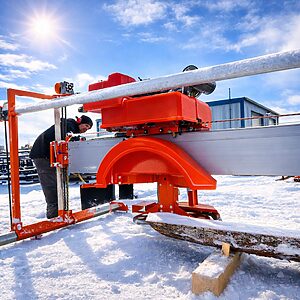
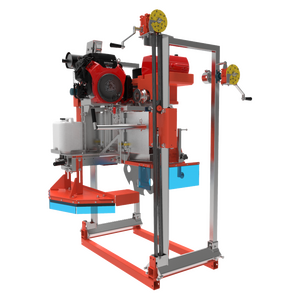
Turbosawmill solves the same job from a different direction. Instead of slicing one horizontal layer at a time and then handling the log, flitches and slabs between stages, a single circular blade swings between horizontal and vertical cuts. That can simplify the complete process of producing finished dimensional timber.
THIN KERF
A genuine bandsaw advantage when maximum single-pass recovery matters.
LESS LOG TURNING
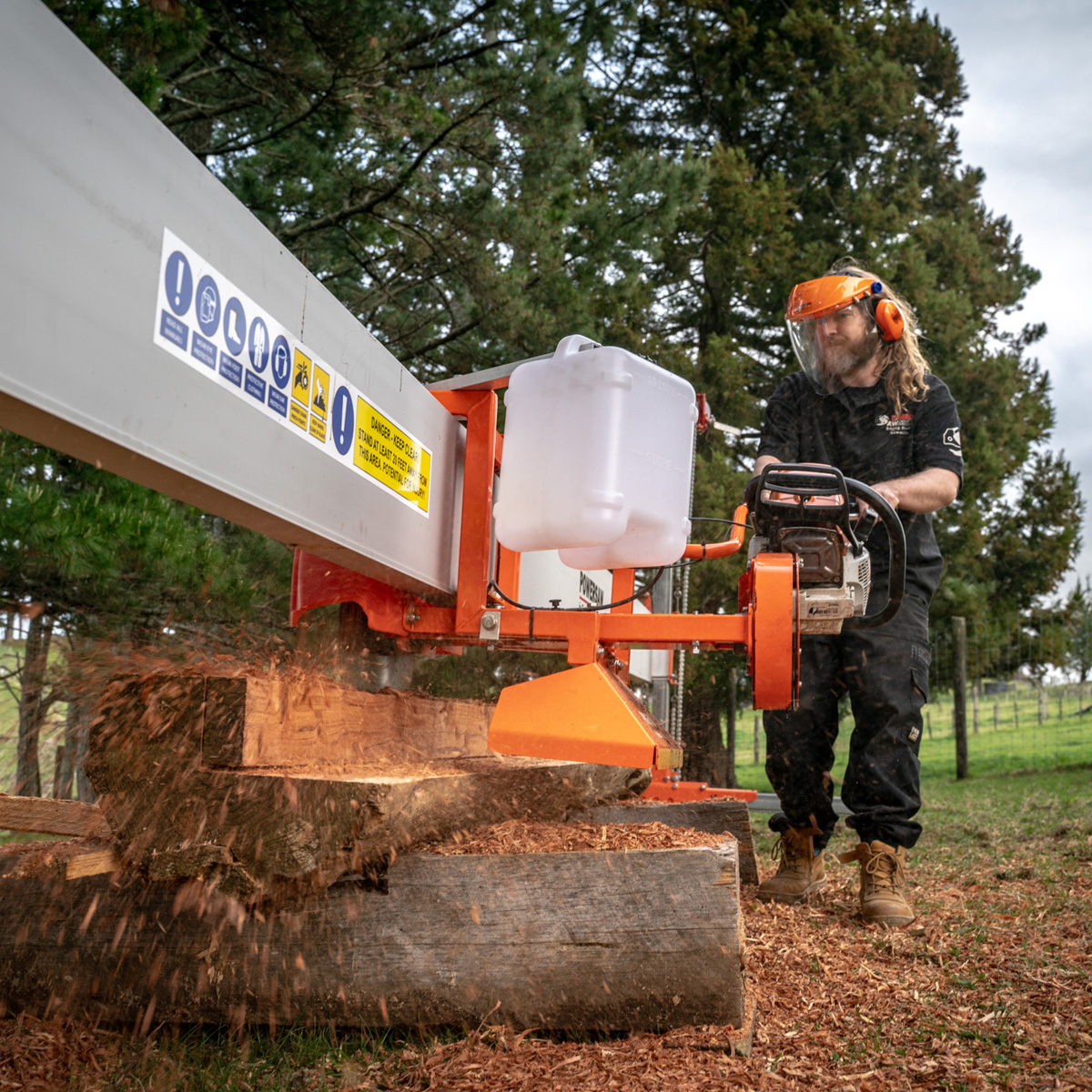
A swing blade can change cutting direction instead of rotating the log.
EDGED ON THE MILL
Boards can leave the swing-blade process already square edged.
ONE MACHINE
Sizing, edging and cutting happen on the same Turbosawmill frame.
Start with what bandsaws do well
BANDSAW MILLS HAVE REAL ADVANTAGES.
A good bandsaw mill is an excellent tool. The thin flexible band removes less wood per pass than a typical circular swing blade, so kerf loss can be lower. A wide throat can also produce a broad board or live-edge slab in a single pass.
That makes bandsaws particularly attractive when your product is wide slabs, when you mill smaller logs efficiently, or when absolute kerf minimisation is more important than reducing downstream handling.
Manufacturers have also developed sophisticated hydraulic systems, board returns, computerized setworks, debarkers, log turners and material-handling accessories that make high-end bandsaw mills extremely capable production machines.
So this is not a question of whether a bandsaw can make good timber. It can. The useful comparison is how much equipment, labour and material handling are required to produce the specific finished timber you want.
Compare the system, not only the saw blade
THE BIG DIFFERENCE IS WHAT HAPPENS AFTER THE FIRST CUT.
A bandsaw head moves horizontally through the log. A swing blade can make both horizontal and vertical cuts. That difference affects log rotation, board edging, material handling and the number of processes required before you have finished dimensional timber.
SLICE. REPOSITION. EDGE.
- The band cuts one horizontal plane at a time.
- The log or cant is repositioned to create new faces.
- Live-edge flitches and slabs may need to be moved away from the mill.
- Finished square boards can require edging or resawing depending on the sawing pattern.
- Manual mills rely on physical handling; hydraulic models add machinery to do much of that work.
CUT. SWING. RELEASE.
- The same circular blade cuts vertically and horizontally.
- The log can remain stationary through normal dimensional milling.
- The cutting pattern can move around the log rather than forcing the log through one sequence.
- Boards and beams can be edged as part of the primary cutting cycle.
- Finished timber exits through the open side for stacking or handling.
| Consideration | Portable bandsaw | Turbosawmill swing-blade |
|---|---|---|
| Kerf | Thin kerf is a major strength and can reduce sawdust loss per cut. | Wider circular-blade kerf, offset by a workflow aimed at finished edged timber. |
| Wide boards / slabs | Excellent single-pass capability within the mill throat. | Double cutting up to model capacity; M10/M12 can also use the attachment slabber. |
| Log rotation | Commonly required as the log is broken into faces and cants. | Normal dimensional cutting changes blade direction rather than rotating the log. |
| Board edging | Depends on cutting pattern; separate edging can improve production of square boards. | Vertical and horizontal cuts create board edges on the same machine. |
| Manual labour | Entry-level mills can involve manual loading, rolling, clamping and slab handling. | Manual M7/M10 still require feed effort, but the log normally stays in place. |
| Hydraulics | Hydraulics can remove much of the heavy log-loading and turning work. | M12 uses hydrostatic carriage feed but does not require hydraulic log turning for normal milling. |
| Quarter sawing | Fully achievable, but commonly involves creating and repositioning quarters/cants and additional handling. | Blade orientation can be changed around the stationary log to follow a quarter-sawing pattern. |
| Maintenance skill | Band selection, tension, guides, tracking, lubrication, tooth geometry and sharpening all matter. | Circular blade alignment and tooth care still matter, but the blade is short, rigid and sharpened on the mill. |
Manual bandsaw vs hydraulic bandsaw
HYDRAULICS SOLVE THE HEAVY WORK — BUT THEY BECOME PART OF THE SYSTEM.
On a basic manual bandsaw mill, the log still has to be loaded, clamped, rolled and repositioned as faces are created. That is why cant hooks, ramps, winches, tractors and other handling aids are so common around manual band mills.
Hydraulic bandsaws address that directly. Wood-Mizer’s hydraulic LT35/LT40 systems use hydraulic loading arms, log turners, clamps, side supports and leveling systems. TimberKing likewise describes hydraulic log handling as the upgrade that removes the hardest physical work.
Those are valuable features. The swing-blade difference is that normal dimensional cutting does not require repeated log rotation in the first place.
See Wood-Mizer hydraulic log handling See TimberKing full hydraulicsA fair comparison is manual-to-manual and hydraulic-to-automated. Comparing a basic manual bandsaw price with an automated swing blade ignores the log handling equipment needed to remove comparable physical work.

The second-machine question
IF THE PRODUCT IS FINISHED BOARDS, INCLUDE THE EDGER IN THE COMPARISON.
A bandsaw can create beautiful wide slabs and flitches directly. When the target product is square-edged dimensional timber, however, a production bandsaw operation often adds a board edger so the main mill can keep sawing while sideboards and flitches are processed separately.
Wood-Mizer describes its edgers specifically as machines for turning flitches, sideboards and slabs into clean square-edged boards. Its current EG100 is generally operated by two people—one feeding and one removing finished boards.
That is an efficient production system, but it is a second machine, another engine or motor, another material-handling step and potentially another person. A swing blade integrates those vertical edge cuts into the primary sawing process.
01
Bandsaw the log
Create slabs, flitches and cants on the primary mill.
02
Remove material
Move pieces away so the main saw can continue production.
03
Feed the edger
Trim bark edges and size the board width in a second process.
04
Stack finished boards
Collect the square-edged timber after the edging operation.
Grain orientation and quarter sawing
BOTH CAN QUARTER SAW. THE HANDLING METHOD IS DIFFERENT.
Quarter-sawn timber can be highly valuable, especially in species where ray fleck, stability and grain orientation matter. Wood-Mizer’s own quarter-sawing guide notes that the method takes more handling and time and generally lowers production compared with plain sawing.
On a conventional horizontal bandsaw, quarter sawing usually means breaking the log into manageable quarters or cants, reorienting those pieces, then sawing them in the required radial relationship. Depending on the target board, subsequent edging may also be required.
A swing blade can instead work vertically toward and around the heart of a stationary log, then switch to horizontal cuts as required. The operator changes the cutting plane rather than repeatedly setting triangular or quartered sections back onto the mill bed.
The bandsaw can absolutely produce excellent quarter-sawn lumber. The swing-blade advantage is primarily reduced repositioning and the ability to edge the board within the same cutting sequence.
Blade systems and maintenance
THIN FLEXIBLE BAND OR SHORT RIGID CIRCULAR BLADE.
THIN KERF REQUIRES CONTROL OF A FLEXIBLE BLADE.
Bandsaw manufacturers engineer sophisticated blade wheels, guide rollers or blocks, blade tension systems and lubrication because a long flexible band has to track consistently through the cut.
- Blade tension and tracking matter.
- Guide adjustment and blade support matter.
- Tooth profile must suit the timber.
- Sharpening and tooth setting are part of normal blade service.
- Many owners keep multiple blades ready so milling can continue while others are sharpened.
SHORT, RIGID AND SHARPENABLE ON THE MILL.
The swing blade is a rigid circular disc. Routine sharpening can be carried out while the blade remains fitted, and insert-tooth versions allow individual cutting tips to be replaced.
- No long band to track around two wheels.
- No band-weld joint.
- No band tooth-setting operation during routine on-site maintenance.
- Blade alignment still matters and must be maintained correctly.
- Different blade types are available for different Turbosawmill applications.
Bandsaw blade technology is mature and highly effective. This section describes the different maintenance disciplines rather than suggesting that one cutting technology requires no maintenance.
Compare equivalent levels of handling
PRICE THE WHOLE SYSTEM — NOT JUST THE SAWHEAD.
Manual bandsaws can offer a very attractive entry price. Norwood’s current HD36V2, for example, starts around the low five figures before optional hydraulic log handling. Baker also lists manual portable models in the mid-teens.
Once hydraulic loading, turning and clamping are added, the comparison moves into a different price category. Current manufacturer listings show hydraulic bandmills ranging from around the high-$30,000s into $60,000+ depending on brand and configuration.
Turbosawmill currently lists the automated M12-35A at $41,500 USD for the US configuration with onsite training, before freight and optional equipment.
Norwood HD36V2
FROM $10,820Base manual configuration shown by Norwood; hydraulic log loading, rolling, clamping and toe boards are optional.
Current Norwood pageTimberKing 1620TW
$38,745Current cash-rebate price shown with essential direct-action hydraulics including log loaders, turner and clamp.
Current TimberKing pageWood-Mizer LT40WIDE Hydraulic
FROM $43,195Current US listing with hydraulic log loading, turning, clamping and powered head controls.
Current Wood-Mizer pageBaker Blue Streak 3638G
FROM $60,215Current hydraulic portable Baker listing with log loader, turner, clamp and hydraulic head movement.
Current Baker pageTimberKing 2020TW
$57,795Current cash-rebate listing for TimberKing’s full-hydraulic industrial-duty portable model.
Current TimberKing pageTurbosawmill M12-35A
$41,500Current US listed machine price including onsite training; freight and optional equipment are additional.
Build the M12Edging can change system cost again. Wood-Mizer currently lists its EG100 twin-blade board edger from $8,995 and notes it is generally operated by two people. Baker’s portable board edger is currently listed from $22,670. These are separate production machines, not requirements for every bandsaw owner.
Price snapshot researched September 2026. All manufacturer prices, rebates, configurations and inclusions can change. Freight, taxes, engines, trailers, hydraulics and regional specifications vary. Use the linked manufacturer pages for current quotations.
Recovery is more than kerf
THIN KERF SAVES WOOD. HANDLING DECIDES WHAT BECOMES SALEABLE TIMBER.
Bandsaw mills deserve credit for thin kerf. When every millimetre of fibre matters, a narrow band can remove less wood from each pass than a conventional circular saw kerf.
But total recovery also depends on the cutting pattern, defects, target board dimensions, stress movement, edging allowance, resawing and what material is ultimately saleable. A narrow kerf does not automatically guarantee the highest finished-product yield.
This is why Turbosawmill focuses on product recovery rather than simply kerf width: choose the board orientation first, change cutting direction around the log, and remove finished dimensions with less intermediate handling.
Compare leading bandsaw manufacturers directly
LOOK AT THE OTHER MACHINES. THEN COMPARE THE COMPLETE WORKFLOW.
We encourage buyers to research the market. Wood-Mizer, TimberKing, Baker Products and Norwood each offer different approaches, model sizes and levels of automation. The links below go directly to the manufacturers so you can evaluate them for yourself.
Wood-Mizer
Large portable-sawmill range from entry-level manual mills through hydraulic and industrial systems, plus edgers and resaws.
Visit Wood-MizerTimberKing
Four-post portable bandsaw range spanning manual, essential-hydraulic and full-hydraulic production models.
Visit TimberKingBaker Products
Portable and industrial bandmills plus resaws, board edgers and larger material-processing systems.
Visit Baker ProductsNorwood
Modular portable mills with a strong emphasis on customer-selected upgrades, including hydraulic log handling and powered controls.
Visit NorwoodForestry Forum
Independent sawyer discussions about mobile milling, hydraulic upgrades, edgers, portability and real-world equipment choices.
Read Forestry ForumTurbosawmill
M7, M10 and M12 swing-blade sawmills built around a stationary log, open-side access and integrated dimensional cutting.
View Turbosawmill productsWhich sawmill makes sense for you?
CHOOSE THE SYSTEM AROUND THE TIMBER YOU ACTUALLY WANT TO SELL.
Choose a bandsaw if thin kerf, wide single-pass boards or slabs and conventional horizontal sawing best match your work. Add hydraulics when you want the machine to take over more of the log handling, and consider an edger when square-board production becomes a bottleneck.
Choose a swing blade when your priority is producing dimensional timber directly from a stationary log, minimising log rotation and intermediate handling, changing cutting patterns around the grain, and keeping sizing and edging within one machine.
PRICE YOUR SAWMILL
need pricing?
click the link below
Select your mill with accessories, delivery and training.