

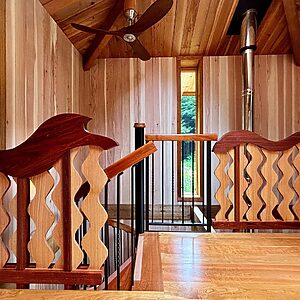

About Turbosawmill / Our family story
OUR STORY.
HIS LEGACY.
Behind Turbosawmill is a family story of invention, practical sawmilling and a belief that there is a simpler way to turn a log into useful timber.
Our portable swing-blade sawmills build on Carl Peterson’s pioneering work. He brought the commercial swing-blade sawmill to the world; today, his son Jake and the Turbosawmill team carry that spirit of invention into the next generation.

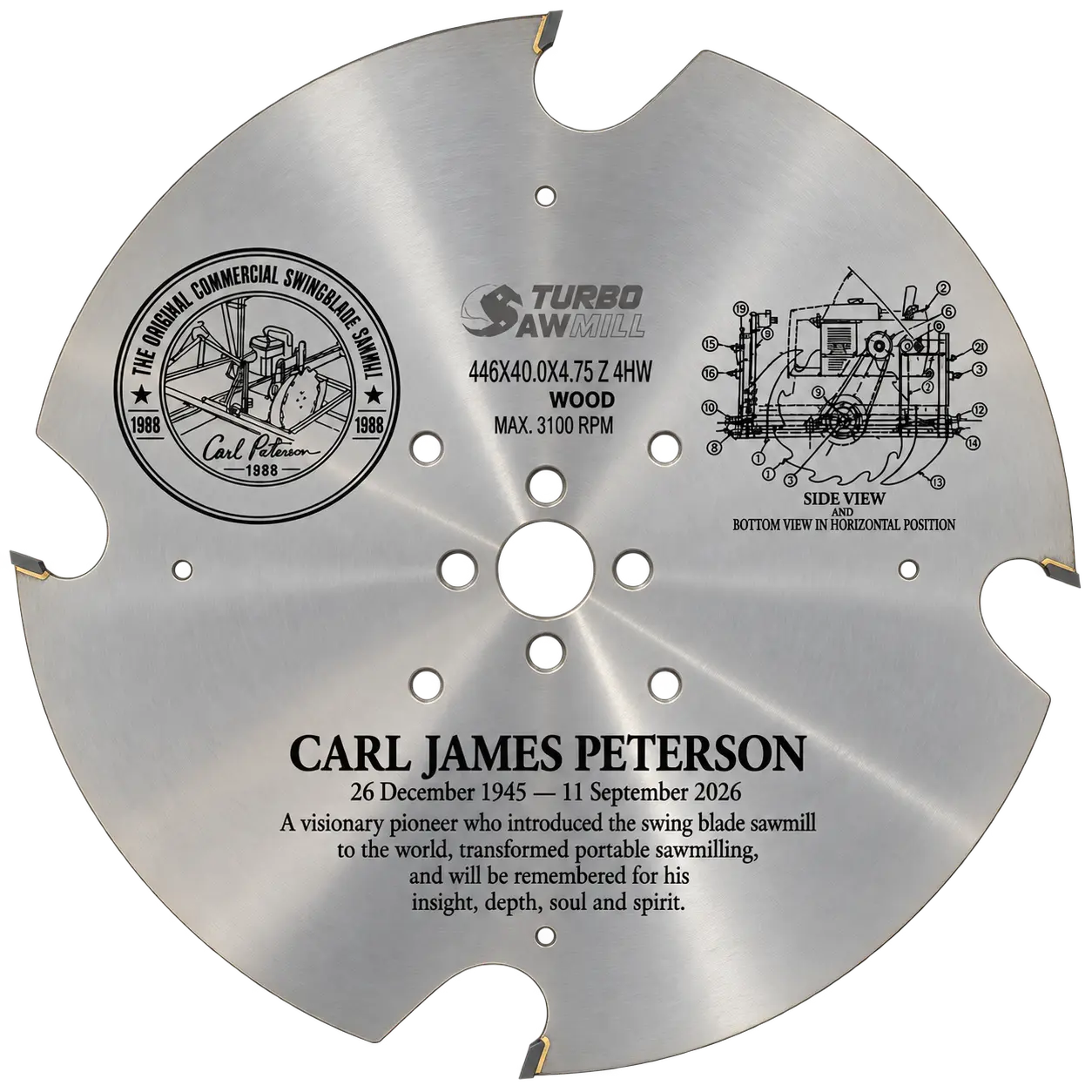
In loving memory
Carl
Peterson
—
A pioneer of portable sawmilling. Carl was the original inventor who brought the commercial portable swing-blade sawmill to the world. He saw a way to bring the sawmill to the timber and make useful boards with a blade that could cut horizontally and vertically.
For our family, his legacy reaches beyond machinery. We remember a father, builder, writer and storyteller: his curiosity, his humour, and the insight and spirit he brought to the people around him.
“A visionary pioneer who introduced the swing blade sawmill to the world, transformed portable sawmilling, and will be remembered for his insight, depth, soul and spirit.”
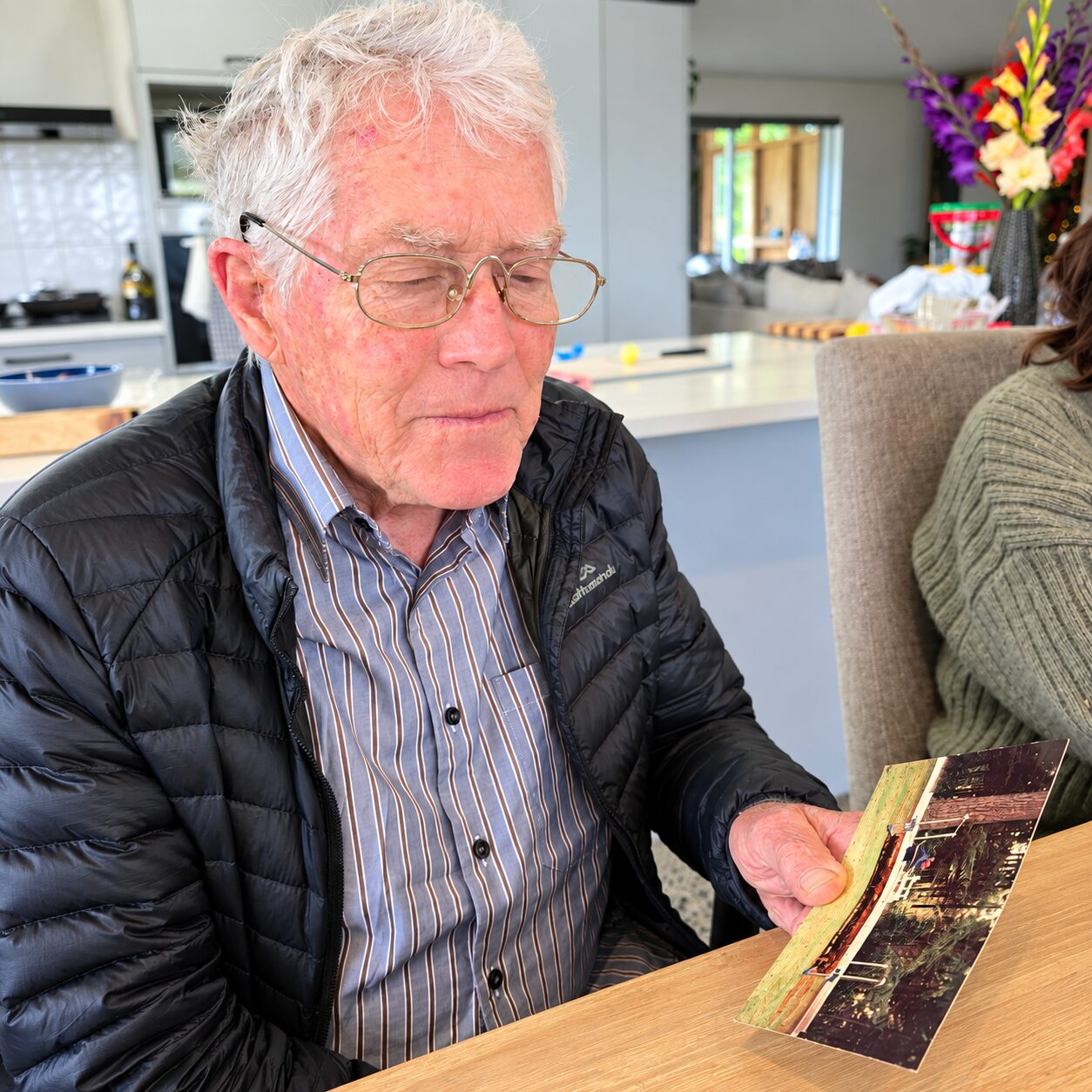
Where the story began
An idea you could
take to the log.
The early tube-frame sawmills were a practical answer to a practical problem: how to produce useful timber without building a permanent mill around it.
Carl’s commercial swing-blade design gave operators a different way to work. One circular blade changed between horizontal and vertical cutting positions, allowing boards to be cut from a log held in place.
Our family photographs connect those ideas with the work behind them: Carl looking back at early mill designs, sharpening a blade on a big job, and testing the first prototype on a farm.
This is the history behind our machines: ideas built, put to work and refined through experience.
What Carl started, we continue
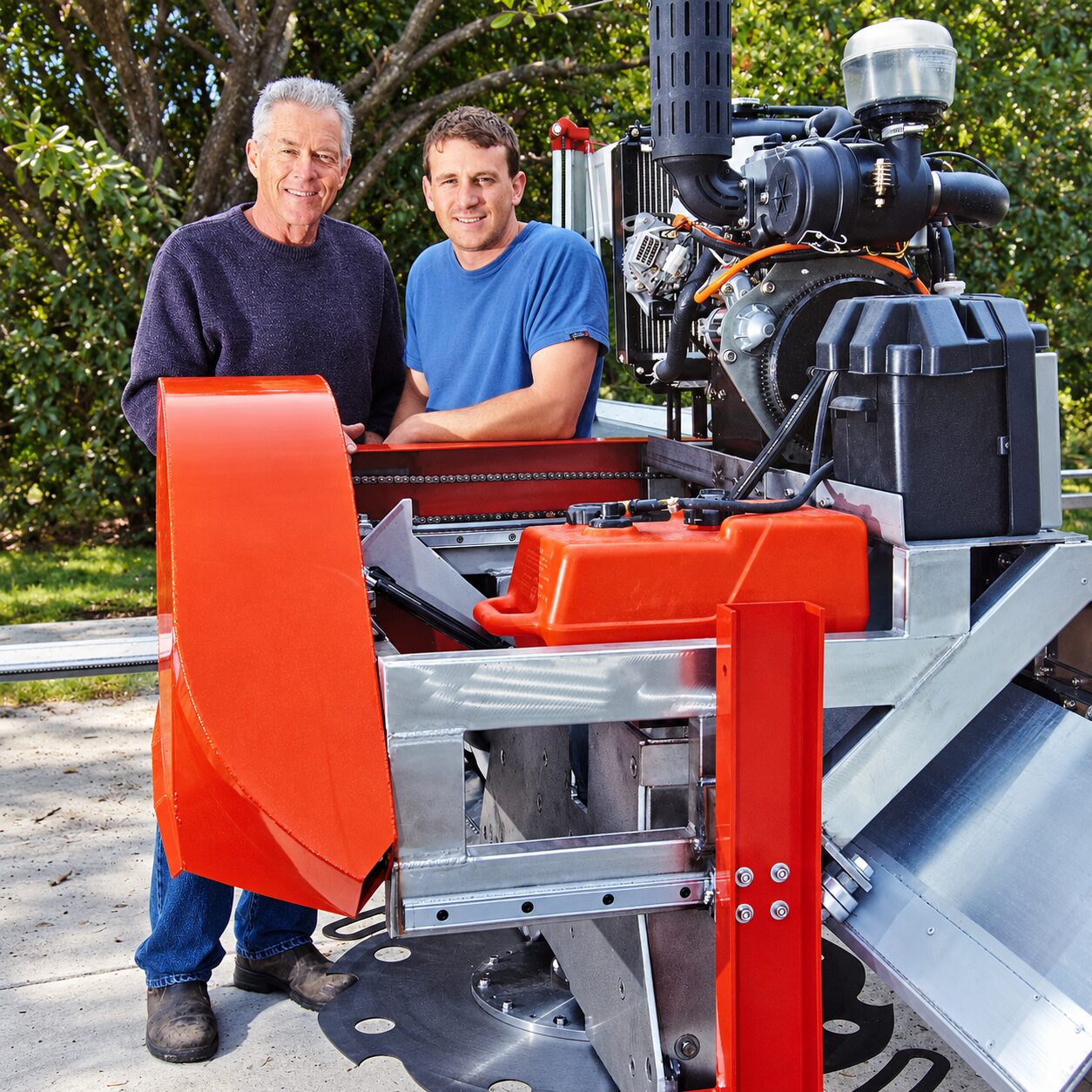
The next generation.
The same practical purpose.
Carl and Jake developed the first Turbosawmill prototype together. That father-and-son connection remains at the heart of our story.
Today, Jake and the team continue to refine the open-sided monorail design. Our priorities are access around the log, straightforward controls and machinery that makes sense to the person using it.
Design with a purpose
Each feature should solve a real problem in the milling day.
Keep the operator in mind
Access, adjustment and maintenance matter alongside the cut itself.
Keep improving
Carry the family’s spirit of invention forward, rather than simply repeat what came before.
From the family archive
A life of building.
A history worth keeping.
Sharpening the blade, testing the prototype and continuing to innovate. These photographs preserve the hands-on work behind Turbosawmill.
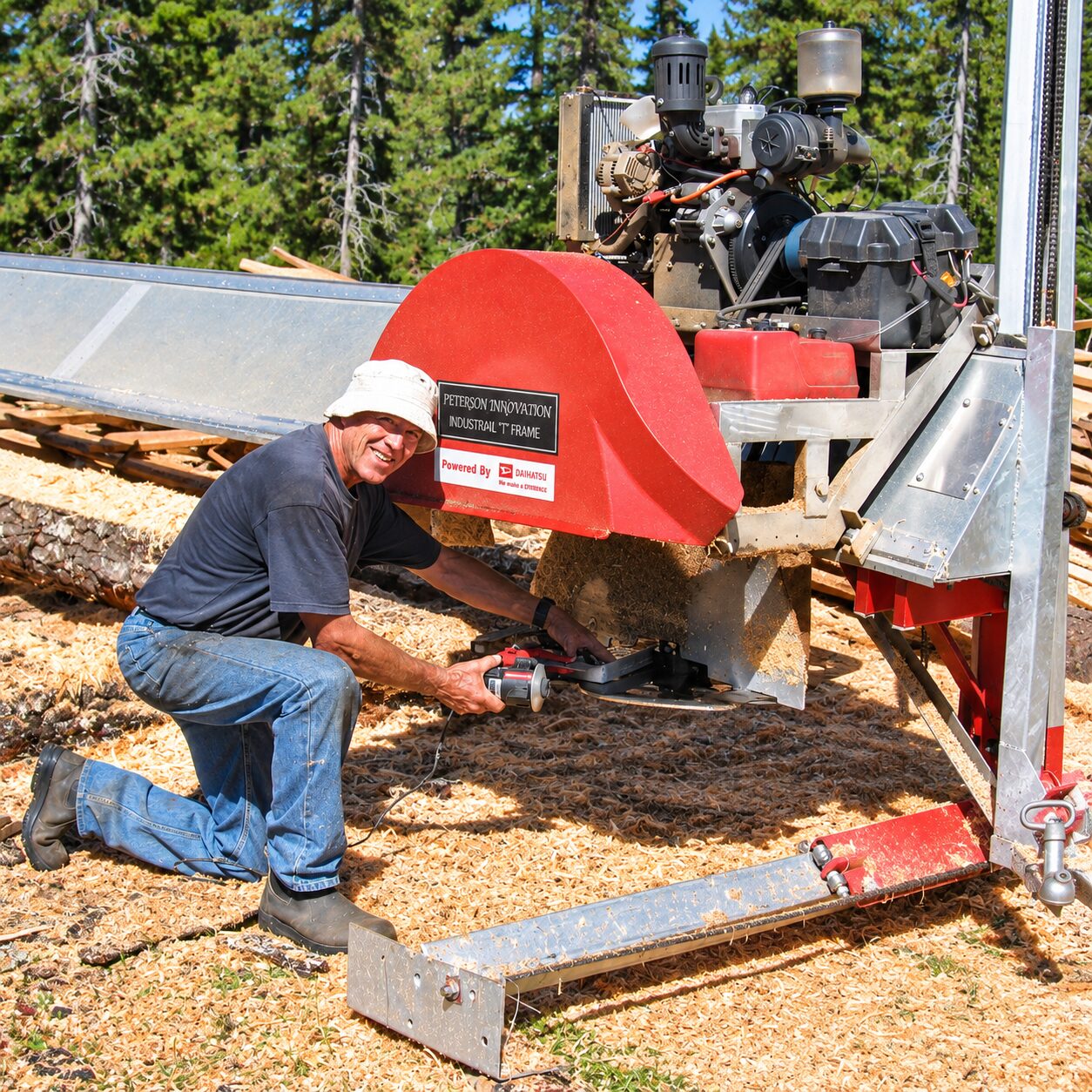
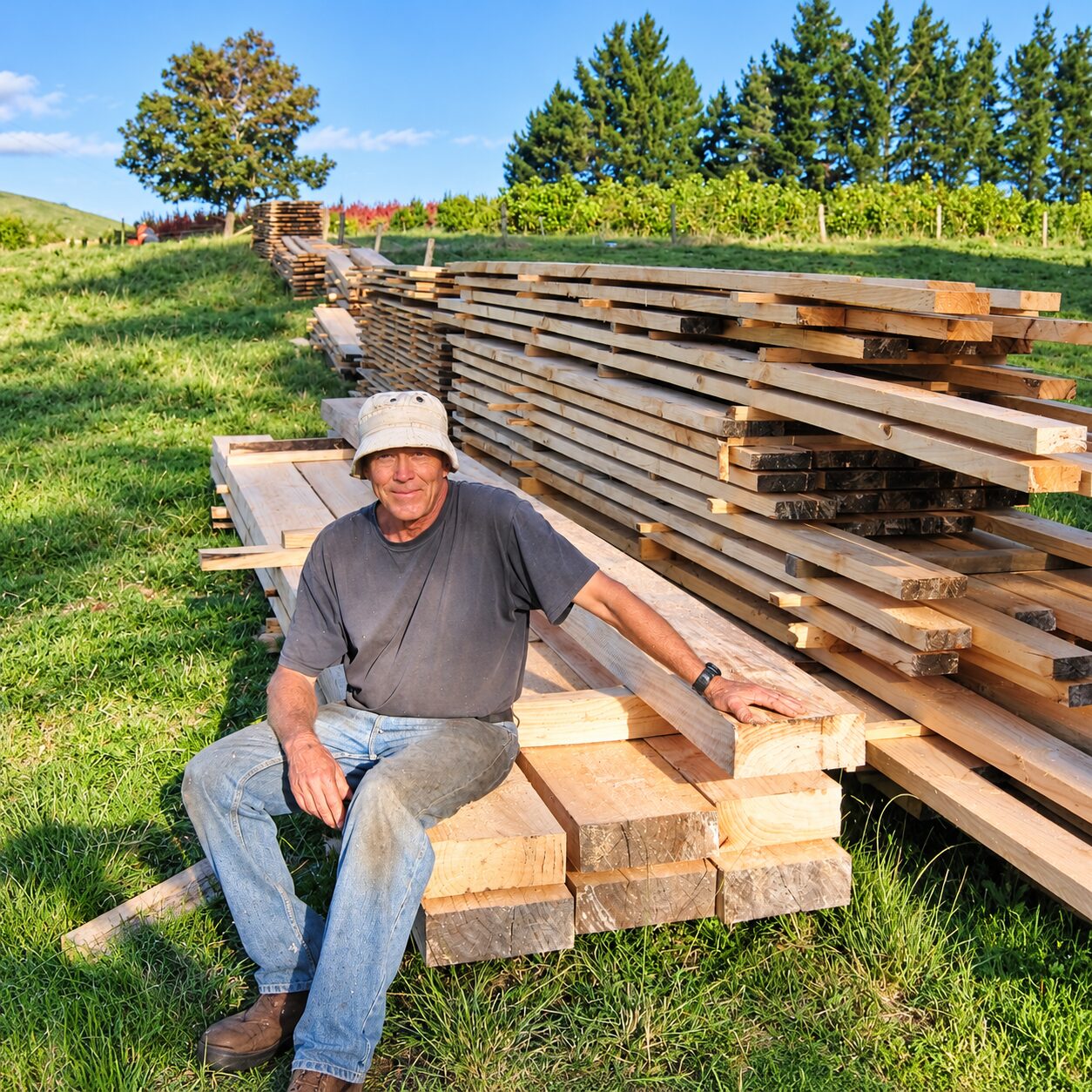
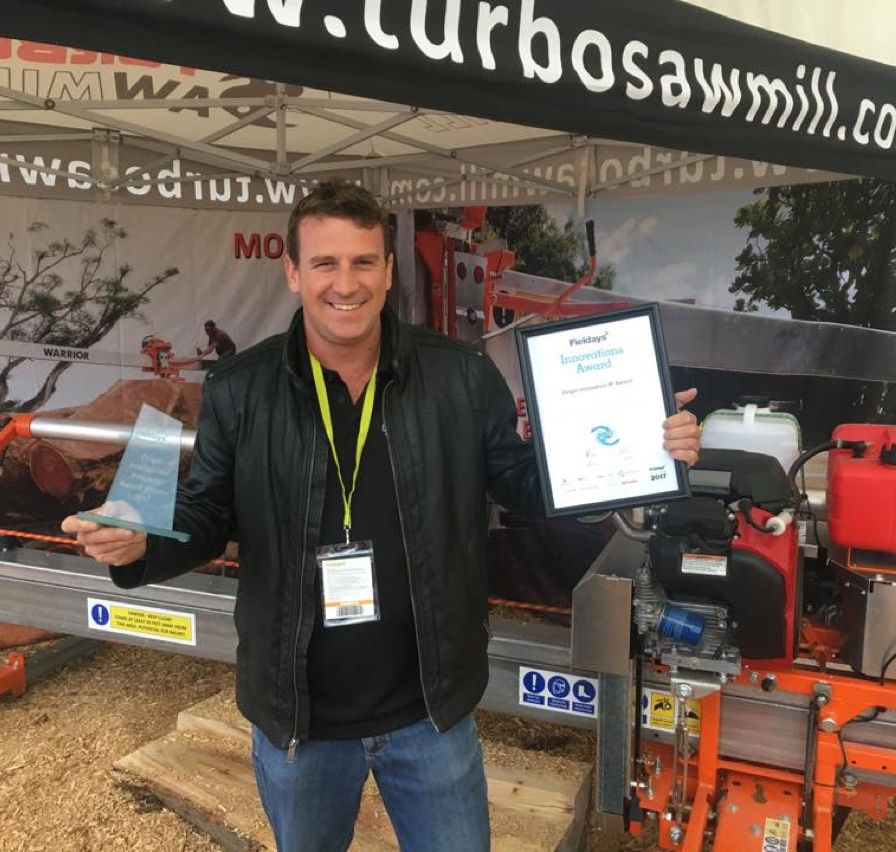
Historical photographs show earlier machines and working arrangements. They are shared as family history, not as current operating or safety instructions.
From the design archive
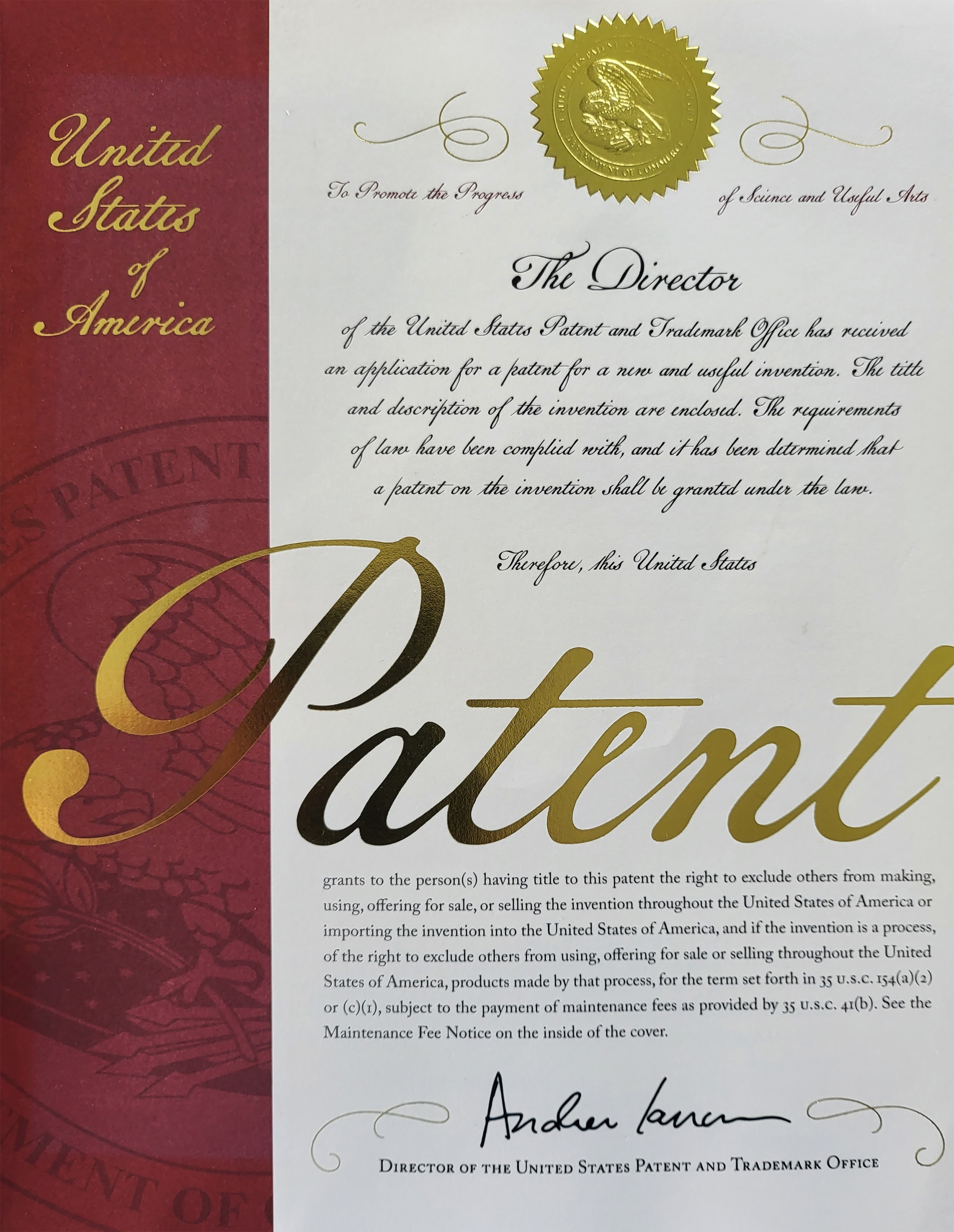
Our United States patent.
This patent certificate cover is part of the Turbosawmill archive, kept alongside the photographs and memories of the machines we developed.
The photograph shows the certificate cover. The patent number and detailed invention specifications are not shown here.
THE DEVELOPMENT
SEE THE HISTORY
These videos show the development of our sawmills over the years, from early prototypes through to the machines we build today. It all began with Carl Peterson’s original swing-blade sawmill and his T-frame concept, which laid the foundation for the design philosophy we continue to develop and refine at Turbosawmill.
THE FIRST TURBOSAWMILL - 2007
logs with Carl and Jake. Known as the Gladiator, this early machine was a key step in the development of Turbosawmill — rugged, productive, and capable of putting out a serious amount of timber.
CARL POWERING THE MILL DOWN THE LOG - 2008
Here we see Carl running the Gladiator, powering the carriage up and down the log and pushing the mill through the cut. This machine could produce timber at a serious rate — even with two off-bearers working behind it, they struggled to keep up with the volume of timber coming off the mill.
FIRST PROMO VIDEO - 2010
This was our first promotional video, showing some of the early ideas we explored while developing Turbosawmill. Watch right to the end and you’ll see one of our more unusual experiments — a twin-blade concept where the front blade could swing down, allowing the machine to operate either as a swing-blade mill or as a twin-blade system.
It was an interesting idea, but ultimately too complicated for the direction we wanted to take. We kept refining the design and came back to what we believed was the better approach: a simple, efficient single swing-blade system.
FIRST COMPUTER SIZING INSTALLED - 2012
Here we see the first Gladiator fitted with computer sizing, developed in cooperation with Tailored Controls. This was one of our earliest moves into automated sizing, combining the original Gladiator platform with electronic control technology.
The machine shown here was operating in Australia with one of our early customers, sawing Australian hardwoods and helping us prove the system in demanding real-world conditions.
OUR FIRST CHAINSAW MONO RAIL MILL - 2013
By 2013, we had developed our first chainsaw-powered swing-blade monorail system — and this was the machine that really helped launch Turbosawmill as a brand.
We sold hundreds of these mills throughout the Pacific Islands, including Papua New Guinea, the Solomon Islands, Vanuatu and Fiji. Its simple, portable design proved well suited to remote sawmilling and played a major role in establishing Turbosawmill in international markets.
FIRST SIMPLIFIED AUTOMATED MILL - 2014
This was the next major step in the development of Turbosawmill — our redesigned automated system using hydrostatic drive.
The breakthrough was working out how to automatically swing the blade at the far end of the log without relying on a complicated network of hydraulics and electrics. It gave us a much simpler automated system while keeping the single swing-blade concept at the heart of the machine.
You’ll also see Carl Peterson in this video, right there supporting me through what was a huge breakthrough in the development of the machine. That support meant a lot, especially as this design became a major turning point for Turbosawmill.
It helped propel the brand further into the United States and other international markets, and marked a major step forward in the evolution of our automated sawmills.
A MORE REFINED SAWMILL - 2015
In 2015, we introduced a more refined automated machine. This was the first design that began to closely resemble the Turbosawmill range we produce today.
The machine brought together the lessons from our earlier prototypes and automation developments into a cleaner, more mature system. It marked the point where many of the ideas we had been refining over the years started to come together in the form that would shape our current generation of sawmills.
THE GROUND FRAME DESIGN
Here we experimented with a full frame version using the same carriage, but with two rails running along the base.
It worked, but it quickly reminded us why we had moved away from this style of design in the first place. Pushing the complete frame up and down the log added a lot of unnecessary weight and effort for the operator.
That experience reinforced our decision to continue developing the monorail system — keeping the moving structure lighter, simpler and easier to operate.
THE RADIAL MASTER
This was one of the more ambitious concepts we developed — a computer-controlled system that could automatically rotate the log as part of the cutting process.
It opened up some fascinating possibilities. You could produce large beams and octagonal sections, and position the log for quarter sawing, rift sawing and other specialised cutting patterns.
The concept worked well, but only one machine was ever built. In the end, it was simply more complicated than we wanted our sawmills to be. We have always preferred machinery that is simple, practical and easy to understand, so we continued refining the single swing-blade monorail system instead.
FROM CARL PETERSON HIMSELF!
I was very fortunate to record my dad, Carl Peterson, talking about his first swing-blade sawmill prototype and some of the adventures that came with building and demonstrating those early machines.
In the footage, Carl shares a little of the story in his own words — the ideas, the early development and some of the experiences along the way. It has become especially meaningful to us because it was recorded only a month or two before his passing.
We are incredibly grateful to have this piece of history preserved in his own voice.
PRICE YOUR SAWMILL
need pricing?
click the link below
Select your mill with accessories, delivery and training.