
LOG RECOVERY.
HISTORICAL AVERAGES.
See the mean recovery of the included Shoot-Out runs and apply it to an approximate log scale. Explore historical averages—not guaranteed yields or tested predictions for current sawmills.
Compiled by TurboSawmill, a sawmill manufacturer. This is our analysis of linked historical sources, not a publisher-endorsed calculator or an official current-product ranking.
TurboSawmill at the Shoot-Out2003–2017Years represented in this dataset
4Historical machine groups
International ¼Log-rule baseline¼ in = 6.35 mm; rule name retained
Historical illustration—not a performance prediction
By default, the calculator uses the arithmetic mean of every available recovery factor in this page’s results pool for your selected machine group. Logs, board specifications, crews, equipment and conditions differed. The results are not controlled like-for-like tests of current products. Averages and scenario outputs are TurboSawmill calculations, not new findings of the original organisers.
Log dimensions
Measure inside bark. Enter either unit or move a slider; the paired value updates automatically. These inputs estimate log scales; they do not establish actual sawn output.
in
mm
6 in / 152.4 mm60 in / 1,524 mm
in
mm
6 in / 152.4 mm72 in / 1,828.8 mm
ft
m
6 ft / 1.8288 m20 ft / 6.096 m
Diameter: inches / millimetres. Length: feet / metres. The paired fields describe the same dimensions; original log-scale equations are unchanged.
The small end sets the log-scale estimates. The large end changes only the solid roundwood volume. Mean recovery = sum of the included recovery factors ÷ number of recovery records. Each run has equal weight; this is not a volume-weighted yield or a prediction for a machine group.
Historical scenario only. Not a tested prediction of output from any particular log or sawmill.
Illustrative lumber · historical factor applied—
Sawn-timber volume equivalent in board feet (BF) / cubic metres (m³) from the calculation below—not a measured yield or a guarantee.
Mean recovery · included runs
—of International ¼ log scale
Selection—
—
—
—
Estimated log scales · not sawn yield
International ¼ log-scale estimate—
Doyle scale · separate reference—
Scribner Decimal C · separate reference—
Solid roundwood · tapered frustum—
Highest values in the listed records
These are the highest numerical values among the included rows only, not all-time records or rankings of current machines. Production and recovery maxima may come from different runs. Time per 100 BF / 0.236 m³ of sawn-timber equivalent is calculated as 6,000 ÷ the listed BF/hour rate (also shown in m³/hour), not a separately timed trial. Mill-plus-edger configurations are identified; no full-day production rate is inferred.
Shoot-Out “recovery” is accepted sawn BF ÷ International ¼ scaled BF. It is not the percentage of solid log volume converted to boards. A factor above 100% means output exceeded the log-rule estimate, not the physical volume of wood.
Behind the numbers
How to read the historical data
This page brings together selected production and recovery figures from historical Shoot-Out publications. Each row describes a named machine and a particular event year. The source publications describe the events; the groupings, calculated percentages, means, maxima and log scenarios on this page are TurboSawmill’s analysis. The sample is not a controlled trial or a complete history of every entrant.
The logs and the measure
The magazine’s accounts describe yellow-poplar logs in several editions. One 2017 report specifies 15-inch (381 mm) and 16-inch (406.4 mm) logs; the 2009 report describes four-log lots with different total scaled volumes. These were short demonstration runs, not a uniform, diameter-by-diameter trial across all years.
The organisers scaled logs with the International ¼-inch rule (¼ in = 6.35 mm), allowing for defects where appropriate. Accepted sawn board feet divided by that log scale gave each mill’s recovery factor. A factor of 100% means the accepted lumber matched the log-rule estimate; it is not 100% of the log’s physical wood volume.
Four historical machine groups
Chainsaw mills included the Logosol M7 and Woodworker’s Mill. Multi-blade circular mills included Mobile Dimension’s 12XLS. Swing-blade mills included Lucas and Peterson, including the smaller Peterson Skillmill. Bandsaw mills included Wood-Mizer, Baker, Timbery, Norwood and others.
These are the machine groupings used by this page, not the original competition classes. The historical setups differ in power, feed systems, log handling, board specification and crew. Bandsaw rows include both stand-alone mills and mills working with a separate edger; the combined group is not a stand-alone-bandsaw benchmark.
Conditions behind the figures
Board specifications differed. The 2007 published rules accepted boards around one inch (25.4 mm) thick. The 2015 Peterson profile describes predominantly 2-inch (50.8 mm) boards with some 1-inch (25.4 mm) boards. The runs across years cannot be treated as identical thickness tests. This calculator does not normalise results for thickness, kerf, log species or crew size. 2007 rules ↗ · 2015 swing-blade account ↗
Separate edgers are part of the recorded setup. A bandsaw working with a separate board edger is a two-machine production setup. The edger can finish boards while the bandsaw continues cutting. Its published BF/hour figure therefore describes that combined setup, not the bandsaw operating alone. The 2007 rules allowed edgers; identifying one is a description of equipment, not a suggestion that its use was improper. Confirmed examples over 1,000 BF/hour / 2.360 m³/hour include Baker 3665 in 2007 (1,020 BF/hour / 2.407 m³/hour) and Wood-Mizer LT70 in 2007 (1,268 BF/hour / 2.992 m³/hour); their magazine profiles explicitly identify the edgers. The 2011 results list Baker Blue Streak 3665D at 1,290 BF/hour / 3.044 m³/hour and Wood-Mizer LT70 at 1,227 BF/hour / 2.895 m³/hour, with separate-edger use corroborated by contemporary first-hand accounts. 2007 Baker mill + edger ↗ · 2007 LT70 + edger ↗ · 2011 rates ↗ · 2011 on-site edger account ↗ · Dave Boyt on the 2011 LT70 ↗
Wood-Mizer also identifies its 2013 LT70 with a twin-blade edger and 2013 LT40 with a single-blade edger. The 2005 LT40 HD Super Hydraulic profile confirms an edger too; that setup is identified below. Timbery describes using an edger in 2017. The records below link the evidence separately where it differs from the numerical result sheet. A high production rate alone is not treated as proof of edger use: the 2009 LT70's 1,144 BF/hour / 2.700 m³/hour result retains an unverified edger flag because the checked summary sheet does not specify its setup. There is no supported way to subtract an edger's contribution from these total rates. 2013 equipment account ↗ · 2005 LT40 HD profile ↗ · 2017 Timbery account ↗
The event reports describe differing log lots, board mixes, crews and equipment. Sawmill & Woodlot’s 2007 coverage describes a shift from competition toward side-by-side demonstrations. The figures describe the individual runs; this page does not use them to establish superiority, typical output or sustainable full-day production for any manufacturer. Read the magazine account ↗
Our participation · historical entries
TurboSawmill at the Shoot-Out
TurboSawmill’s account is that we entered automated machines to demonstrate their operating method and handling. This page does not claim that our event runs, or another entrant’s runs, establish sustained full-day production.
2015 — 10-inch (254 mm) automated Warrior. NZ Herald reports Jake Peterson’s figure of 531 BF/hour / 1.253 m³/hour. The exact accepted-lumber tally and log-scale figures have not been verified here, so recovery remains Unavailable. The published account contributes to the production mean only. It is not presented as an independently recovered official tally sheet.
2017 — 6-inch (152.4 mm) automated Warrior M6. The 3 October 2017 Forestry Forum announcement schedules Turbo Warrior M6 for 7 October at 10 a.m. That source establishes the scheduled entry, not its performance. TurboSawmill reports a one-operator demonstration affected by freight-damaged equipment; that is our account, not a finding in the announcement. Numerical production and recovery remain Unavailable, and the entry contributes to neither mean.
Year by year: calculated means of included runs
Each category cell below shows mean recovery / mean BF per hour and m³ per hour calculated by TurboSawmill for the included rows of that type and year. These are descriptive arithmetic means, not the organiser’s rankings or expected performance. The TurboSawmill column names our individual entries so they remain visible alongside the group averages. The small n counts recovery records; the production average may use a different number of records. A dash means no entry for that category in this dataset.
| Year | Chainsaw | Multi-blade circular | Swing-blade | Bandsaw | TurboSawmill entry |
|---|
All eight archived event years from 2003 to 2017 appear above. Coverage is thin for some years and machine types. Read the individual linked runs below before treating a group average as representative of the full history.
Entrant audit: what the available records establish
Every entrant row from the 2003, 2005 and 2007 result sheets is represented using the selected production and recovery fields shown here; not every original column is reproduced. Across all years, however, the records table remains a documented sample, not the full historical entrant list. For 2015 we can verify individual published profiles for Timbery M285, Lucas 10EFI and Peterson WPF, plus the contemporary account of TurboSawmill’s 10-inch (254 mm) Warrior. Peterson also reports entering a Junior Peterson, whose numeric result is not in this table. Other entrants may be absent. For 2017, a pre-event lineup posted by Peterson named Baker 3665D, Wood-Mizer Super LT70, Wood-Mizer LX450, EZ Boardwalk 40, Norwood LumberPro HD36, Lucas 8 EFI, Peterson WPF 10/35, EZ Boardwalk Jr., Norwood Frontier OS27, Lucas 6-18, Timbery M280, Turbo Warrior M6 and Wood-Mizer LT28. These are scheduled machines, not a verified list of completed runs: the same thread reports that the Junior Peterson did not arrive. The full official entrant and results sheets are needed to establish every actual 2015 and 2017 run. Missing entrants must not be silently counted as zero or represented by a group mean.
Across the included years · TurboSawmill calculations
These percentages are arithmetic means of the included recovery factors, not physical wood-volume recovery, market averages or predictions for current products.
Historical Shoot-Out records
Historical sample—not a current-product ranking. Figures relate to particular models, crews, equipment and conditions in the named years. Coverage is incomplete and the sample is not a controlled like-for-like comparison.
Original figures and our analysis are different. BF/hour values are retained as reported in the linked source or published account. Recovery percentages are ratios calculated from reported tallies where available, or the source’s stated factors. Averages and maxima are TurboSawmill’s calculations. A scheduled entry without numerical results is not treated as a completed measured run.
TurboSawmill · 2015 · 10-inch (254 mm) Warrior531 BF/hour / 1.253 m³/hour · published account · recovery: Unavailable
TurboSawmill · 2017 · 6-inch (152.4 mm) Warrior M6Scheduled entry confirmed · production: Unavailable · recovery: Unavailable · one-operator account: TurboSawmill
The table includes TurboSawmill’s 2015 published account and 2017 scheduled entry. Both entries appear in the table below. “Unavailable” means no numerical result could be verified from the accessible publications. The default mean recovery is the unweighted arithmetic average of all available recovery factors for the selected machine group in this dataset: sum of the factors divided by the number of recovery records. Each event/model row counts once, regardless of log-lot volume; it is not the ratio of total lumber to total log scale. Different-year runs by the same manufacturer are separate observations. No numerical row is excluded just because its recovery is high or low. Mean production uses only runs with a published BF/hour figure; an entrant listing without figures contributes to neither numerical mean. These are means of the available documented runs, not all Shoot-Out entrants. A separate edger is flagged where confirmed; “Unknown” means unverified, not that no edger was used. Confirmed mill-plus-edger rates remain in the bandsaw included-run mean, which is therefore a mixed-equipment comparison, not a stand-alone-bandsaw average. Most reports do not list both end diameters for each log lot.
| Year | Sawmill | Type | Published BF/hr / m³/hr | Recovery vs International ¼ log scale | Separate edger | Source |
|---|
Metric equivalents: 1 BF = 0.002359737216 m³; 1,000 BF ≈ 2.360 m³. The m³ figures alongside BF or BF/hour are TurboSawmill unit conversions of the sawn-timber tally or historical illustration, not separately measured results. Converted log-scale figures are labelled m³-equivalent; they are not solid round-log volume or a different log rule. Solid roundwood volume remains separately labelled. Recovery percentages do not change with the display units.
Sources and method: 2007 magazine report and scoring rules; 2009 official results; 2011 official results. University of Florida log-rule equations provide the three scale estimates. The 2003 results are from Sawmill & Woodlot's final-results sheet, preserved in the Lucas Mill archive (PDF page 3 / magazine page 26). The 2005 table (PDF page 181 / magazine page 21) and 2007 table (PDF page 244 / magazine page 12) are from Sawmill & Woodlot's published Shoot-Out reports. The links open the relevant pages in the source document. Each of these three result sheets contributes every entrant row once, using the fields selected for this page. Later years use the linked result sheets, profiles and contemporary accounts; coverage is incomplete. Entrant schedules are not treated as numerical results. Unverified figures remain Unavailable and are excluded from the relevant mean.
Calculation: The magazine scaled log lots using the International ¼-inch rule, sometimes adjusting for defects, and measured only accepted boards. Here, small-end diameter sets the unadjusted log scale, using a published 16-foot (4.8768 m) equation prorated to the entered length; large-end diameter affects only the tapered solid-wood volume. The selected included-run mean or individual recovery factor is then multiplied by the International estimate to create a historical scenario, not a prediction. Doyle and Scribner are shown for comparison alone. The original runs used varying board widths and both 1-inch (25.4 mm) and 2-inch (50.8 mm) stock; no thickness-specific recovery or kerf correction can be inferred from the published summary data. The input limits are interface limits, not a validated prediction range. No correction is made for species, defects, board specification, operator or model. Longer, wider, more tapered and defect-heavy logs may behave differently. Display rounding is for readability; calculations use unrounded values. Different source precision, defect deductions and event rules also limit comparability.
Run context matters. Known source qualifications are shown with the relevant rows, including reported equipment interruptions and the difference between an official result sheet and a participant’s published account. The absence of a note does not establish that a run was incident-free. No adjustment is made to a published numerical result to excuse an interruption or estimate what a machine might otherwise have achieved.
The listed records do not establish present-day product specifications, overall build quality, safety, typical recovery or full-day production. Check the source report and current product information before making a purchasing decision.
Source attribution and brand identification. Compiled by TurboSawmill, a sawmill manufacturer. Manufacturer and model names identify historical entrants only. Their inclusion does not imply affiliation with, sponsorship of, or endorsement of this page by other manufacturers, the original publishers or event organisers. Source links are citations, not endorsements of this calculator or its analysis.
Source material. Any rights in the original articles, photographs and layouts remain with their respective rights holders. This page does not grant a licence to reuse third-party material. It does not alter any applicable statutory consumer rights.
Corrections and source enquiries. To report a transcription error, missing context or a rights concern, contact TurboSawmill with the model, event year and source reference so the record can be checked.
2015 SHOOTOUT A
AUTOMATED M10 ENTRANT
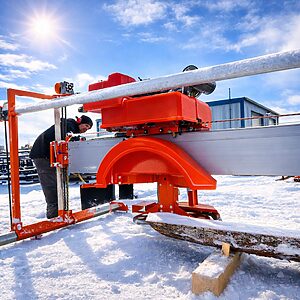
Jake Peterson attended his first sawmill shootout in 2015, operating the Turbo Sawmill with Mike Moen off-bearing the timber. It was Jake’s first time operating the mill at a shootout, and nerves were high. He ran it at a reasonable, consistent pace—the kind of pace an operator could maintain throughout a working day.
2015 SHOOTOUT B
OPERATOR VIEW
This 2015 shootout footage was filmed with a GoPro mounted on the operator’s helmet, giving you a first-person view of the cut. We used a kerf blade and stacked the logs in an unusual pyramid arrangement. Our one regret is that we supported the logs on four-inch blocks instead of six-inch blocks. That left too little clearance to swing the blade through the bottom cuts without hitting the dirt, so we missed a few final boards. We even stopped to sharpen the blade!
2017 SHOOTOUT
AUTOMATED M6 ENTRANT - One person running the mill
For this shootout, we entered our smallest automated mill at the time and chose to run it with a one-person crew. Jake Peterson operated the machine entirely on his own. When we opened the crates at the Paul Bunyan show, we found damage to the shafting and possibly the blade, but decided to compete anyway. The blade wobbled, the kerf was wider than usual, and we had to slow the feed rate, all the while being restricted to only 4" cuts. Even so, we recall producing just under 500 board feet per hour. We’re still trying to recover the official results and recovery percentage; the online records appear to be gone, so we may need to ask Sawmill Magazine for its archived editions. Another interesting addition here is we added longer skids. You can go as wide as you like to fit as many logs as needed in one milling cycle.