


Turbosawmill / Pacific Northwest
Portable sawmills in Oregon.
Big logs. Your land. Your lumber. Turn Oregon timber into boards and beams with a portable swing-blade sawmill. From private woodland to a working sawmill business, find the Turbosawmill that fits what you want to cut.

Find your starting pointThree mills.
Three mills.
Your way of working.
Compare the M7, M10 and M12 by the timber you want to produce and the way you want to operate. Each model page explains its specifications, features and available options.
Chainsaw-powered / Manual
M7 PowerSaw
A compact starting point for property owners, hobby milling and small-scale projects. Put your own compatible chainsaw to work with swing-blade cutting.
- Nominal standard cut
- 7″ × 7″
Manual / Upgradeable
M10 M10-25M Sawmill
A versatile manual mill for boards, beams and regular property work. Single-end sizing keeps adjustments together, with optional powered feed as your workload grows.
- Nominal standard cut
- 10″ × 10″
Automated / Larger cutting capacity
M12 M12-35A Sawmill
For larger timber dimensions and a production-focused workflow. Hydrostatic feed and single-end sizing help you work through repeated cuts with less manual feeding.
- Nominal standard cut
- 12″ × 12″
These are nominal timber-cut sizes, not maximum log diameters. Follow each model page for double-cut capacity, working dimensions and current options.
Compare the full sawmill range
Built around the log
Big timber.
Big timber.
Less turning.
More possibilities.
A large log is valuable timber—and a serious handling task. Turbosawmill's open, single-beam design gives you access to the log while the blade alternates between horizontal and vertical cuts.
That makes a swing-blade sawmill a practical option for Oregon owners turning larger logs into edged boards and beams. Choose the model around your finished timber sizes, log dimensions and worksite.
Explore the swing-blade advantagesKeep the log in place.
For typical dimensional milling, the securely supported log stays stationary while the blade changes cutting orientation. Produce boards without repeatedly rotating a heavy log between cuts.
Reach the timber you need.
The open side gives access for positioning logs and removing finished timber. Plan your setup and handling equipment around the weight and dimensions of the material.
Cut boards and beams directly.
Horizontal and vertical passes produce edged timber from the log. Double cutting opens up wider board options within each model's capacity.
See the cutting process
A state shaped by timberOregon timber.
Oregon timber.
Plenty to work with.
Western Oregon's rainfall and mild climate support productive forests and large Douglas-fir and western hemlock trees. Across the Cascades, drier forests bring a different mix of pine and other conifers.
For woodland owners and custom sawyers, that variety creates opportunities to turn locally sourced logs into useful lumber. The species, size and condition of your available logs should guide your sawmill choice—not simply the diameter of the largest tree on the property.
Douglas-fir
A defining species of western Oregon's forests, and a familiar timber for sawyers producing boards and substantial beams.
Hemlock & cedar
Western hemlock and western redcedar are part of the wetter western forest mix, offering a range of softwood milling projects.
Ponderosa pine
A characteristic tree of central and eastern Oregon's drier forests, broadening the state's softwood resource beyond the coast.
Alder & maple
Red alder and bigleaf maple add hardwood possibilities, including boards for furniture, joinery and other value-added projects.
Forest background: Oregon Department of Forestry and Oregon State University Extension.

Meet the people. See the mills.
A familiar face
A familiar face
at the Oregon show.
We regularly return to the Oregon show to demonstrate our sawmills, meet customers and help new owners get to know their machines.
Oregon has become an important market for Turbosawmill. We have seen strong sales and a warm reception for our swing-blade design among people who understand timber—and have plenty they want to put to use.
These photographs capture that connection over the years: mills ready for collection, owners getting hands-on at the show, and a customer's mill at work in their own woodland.
Ask about an Oregon demonstration
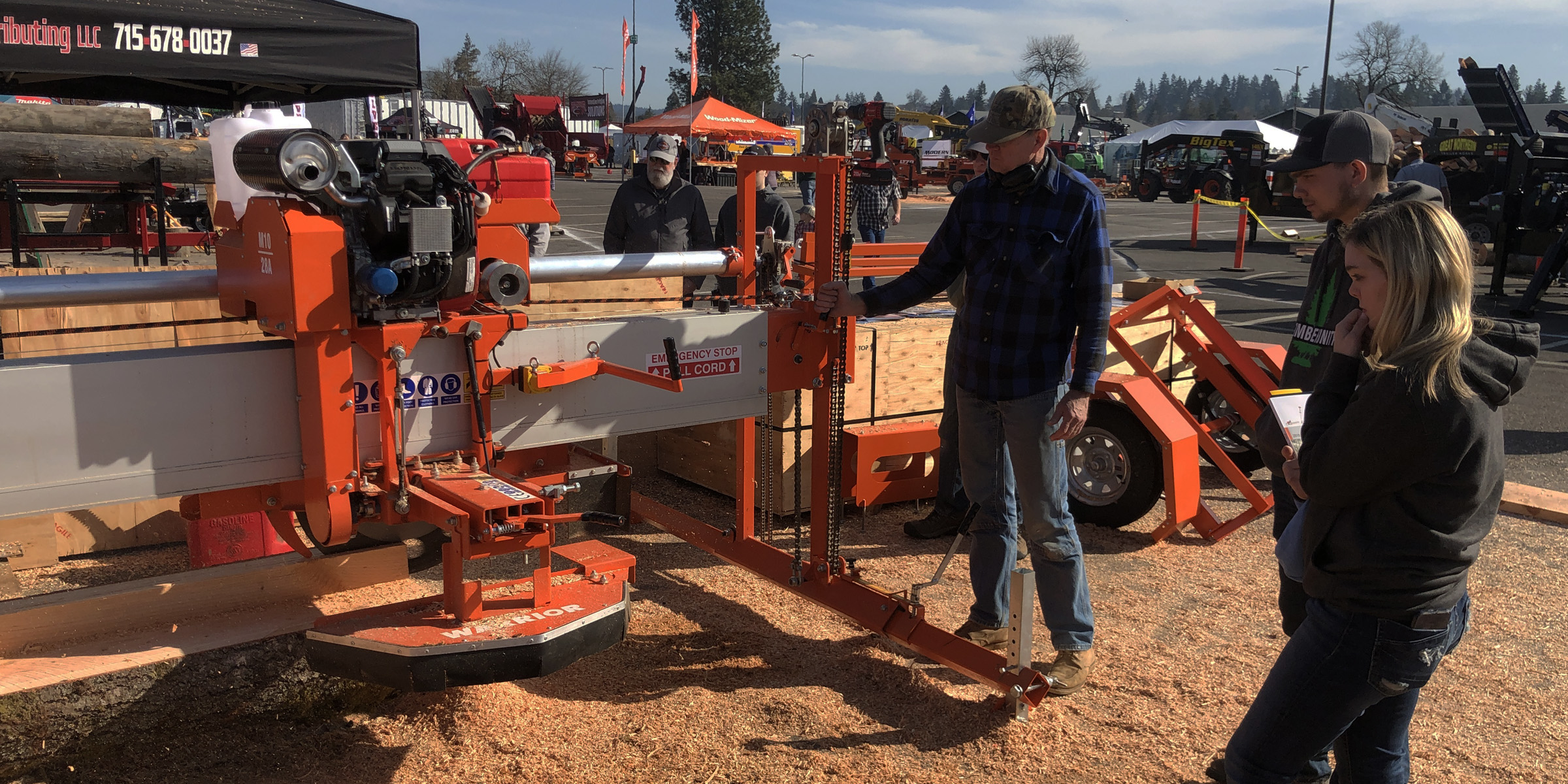
Photographs show earlier machine configurations. Explore the current Turbosawmill range for today's equipment and options. Contact our team to confirm upcoming demonstrations and availability.
Make an informed decisionYour next question.
Your next question.
The right place to look.
Go straight to the details that matter to you—from understanding the cutting process to planning your delivered sawmill package.
Before you chooseBuying a portable
Buying a portable
sawmill in Oregon.
Which portable sawmill is right for my Oregon property?
Start with your timber species, typical log size, required board or beam dimensions, and how often you plan to mill. The M7 is a compact chainsaw-powered option; the M10 offers manual milling with upgrade options; the M12 adds larger cutting capacity and an automated feed workflow. Compare the sawmill range to narrow down your choice.
Can a swing-blade sawmill handle large Oregon logs?
The open layout and stationary-log cutting method are useful for larger logs because typical dimensional milling does not require repeated log rotation. The practical fit still depends on the model, setup, log dimensions and finished timber you need. See the design advantages and discuss your largest logs with our team.
Can I see a Turbosawmill operating at an Oregon show?
Turbosawmill regularly attends the Oregon show, and the photographs above show past demonstrations and customer collections. Contact our team to confirm upcoming attendance, demonstration arrangements and which models will be available to see.
Where do I find US pricing and delivery to Oregon?
Use the US sawmill pricing tool to select your model, accessories and delivery location. For a specific order, confirm the delivery address, access requirements, availability and timing with our US team.
Do I need to be an experienced sawyer?
Understanding the cutting process is a useful first step, followed by instruction for your chosen machine. Start with our swing-blade sawmill operation guide, then ask about training for your purchase and the setup you plan to use.
From Oregon logs to your next projectWhat would you
What would you
like to cut?
Tell us about your logs, the lumber you want to produce and where you are in Oregon. We will help you choose a mill and put together your package.