

US 207-200-1920
February 22, 2024
◉ David Shore – M12-28A (editorial).
Turbosawmill Portable Swing-Blade Mills Gain Ground in the United States
Automated Warrior Model Proves Ideal for Custom Woodworkers
By Diane Calabrese – Timberline Magazine
DUDLEY, Georgia —
“Why not?”
That was the question David Shores heard repeatedly—from customers who admired his custom woodwork and from friends who knew his passion for timber.
Why not buy a portable sawmill and cut his own lumber?
David had considered it for years, but it wasn’t until 2019—after moving from the city to rural Georgia and acquiring acreage—that he began seriously exploring the idea of owning a mill.
From the outset, he knew exactly what he wanted: a circular swing-blade sawmill capable of producing quarter-sawn lumber. Unlike band mills, swing-blade systems use a circular blade that pivots 90 degrees, allowing both horizontal and vertical cuts. This capability makes it possible to produce accurate dimensional timber directly from the log, while also cutting forward and backward for greater efficiency.
After extensive online research and countless hours watching demonstrations, David discovered Turbosawmill, a New Zealand-based manufacturer of advanced swing-blade sawmills. The more he learned, the more convinced he became that he had found the right system.
A Sawmill Built on Experience
Turbosawmill was founded by Jake Peterson, who grew up immersed in the swing-blade industry.
“I wanted to build a better, more practical swing-blade sawmill based on everything I had learned from real-world milling,” Peterson explained.
From a young age, Peterson had been involved in operating, designing, and improving swing-blade mills. His philosophy was simple: build machines that are powerful, intuitive, reliable, and versatile.
“Our goal has always been to keep the system simple to operate and maintain, while maximizing capability and productivity,” he said.
David quickly recognized those qualities in the Turbosawmill design.
“It’s simple to use, performs exceptionally well, and the support from the manufacturer has been excellent,” he said. “It’s a solid, well-engineered machine.”
From First Mill to Automated System
David purchased his first Turbosawmill in 2020—a 10-inch Automated Warrior model. Within a year, he decided to upgrade to the 12-inch Automated Warrior system.
“The main reason was the factory-installed digital sizing system,” he explained.
The computerized setworks provides precision, repeatability, programmable cutting patterns, and push-button control. It also enables section cutting, which breaks deep cuts into manageable passes—particularly valuable when milling dense hardwoods or stressed logs.
“In difficult logs, section sawing allows you to produce high-quality timber instead of fighting the wood and burning blades,” Peterson noted.
David’s upgraded mill is powered by a 25-hp Honda petrol engine, which he describes as an ideal match for the system.
Overcoming the Limits of Traditional Mills
During his research, David had initially considered a band mill. But the deeper he looked, the more limitations he identified: log size restrictions, dependence on hydraulics, frequent blade changes, sharpening costs, and the need for heavy equipment to handle logs.
By contrast, the Turbosawmill’s open monorail design allowed him to position the mill directly over large logs—eliminating the need to move timber with machinery.
Many of the logs David has milled since purchasing his Turbosawmill would have been impossible to process on a typical band mill.
A Woodworker’s Journey
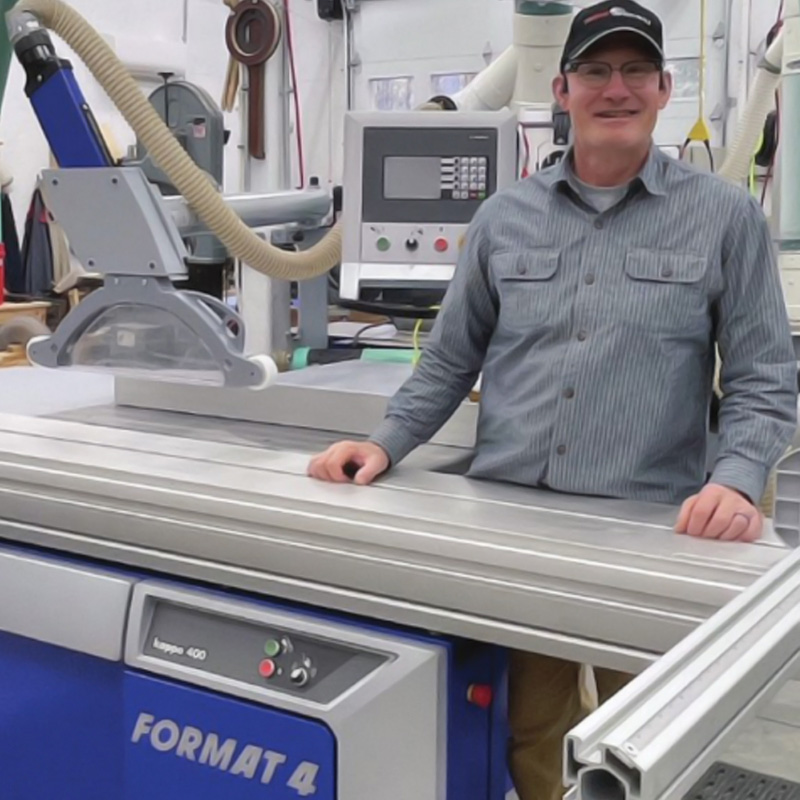
David, now 59, has been a hobby woodworker for decades. Originally from Michigan, he moved to Georgia 30 years ago and now operates a fully equipped 1,500-square-foot workshop in Dudley.
His projects range from furniture and architectural timber to custom metal-and-wood pieces. Most of the lumber he mills comes from his own property or nearby landowners—turning trees that might otherwise be discarded into valuable material.
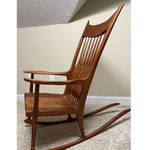
Using Turbosawmill-produced timber, he has built a 30×40 pole shed, lean-to structures for air-drying lumber, and numerous custom projects, including a sculpted cherry rocking chair inspired by Sam Maloof.
A Shared Philosophy
Peterson sees David’s story as representative of a broader Turbosawmill community.
“Our customers range from landowners and hobbyists to commercial operators and contractors,” he said. “What they all share is the desire for a system that’s capable, efficient, and adaptable.”
With features such as narrow-kerf insert blades, slab-cutting attachments, planer heads, and trailer kits, Turbosawmill systems continue to attract operators seeking flexibility without complexity.
For David, the appeal is simple.
“The best part is creating something tangible with your own hands,” he said. “Turning raw logs into timber and ideas into real objects—that’s what makes it all worthwhile.”
Contact Us
Message our team today, wherever you are in USA, and we’ll get right back to you.