

US 207-200-1920
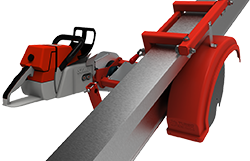
◉ John Bailey – M10-22A (showcase).
“$240,000 in Timber Value — and Still Cutting”
John Bailey, Norfolk Island
Machines: Turbosawmill M10-22A and M12-28A (second mill recently added)
After nearly 590 engine hours of operation, John Bailey’s Turbosawmill systems on Norfolk Island have delivered results that far exceed expectations.
“By our calculations, the mill paid for itself more than ten times over — and we’ve cut a lot more since then.”
Performance and Output
To date, John’s mills have achieved:
Nearly 590 Honda engine hours
Average production of around 4 cubic metres per day (often underestimated depending on log size and site conditions)
More than 300 cubic metres processed to date (approx. 126,600 board feet)
Timber value exceeding $240,000 — likely significantly more
“These figures are conservative,” John notes. “In reality, we’ve probably produced far more than we’ve recorded.”
Real-World Milling on Norfolk Island
Operating conditions on Norfolk Island are far from gentle. The mill is frequently set up in exposed coastal environments, often on windswept clifftops under large pine trees.
“We move the mill around the island to avoid hauling logs,” John explains. “It’s faster to bring the mill to the timber than the timber to the mill.”
Setup time averages around 30 minutes.
“It usually takes me longer to find where I left the truck’s tow ball than it does to set up the mill.”
To handle oversized logs, John and his team engineered adjustable leg extensions, enabling them to mill butt logs exceeding 1.4 metres in diameter — sometimes working from a step ladder.
The primary species milled include:
Norfolk pine
Tallowwood
Spotted gum
Ironbark
Silky oak
Durability and Maintenance
Despite harsh coastal conditions, corrosion has been minimal.
“The mill hasn’t spent more than two months in a shed since we bought it,” John says. “Considering the salt air, there’s surprisingly little rust.”
Maintenance has been straightforward and minimal:
Occasional lubrication of chains with Ballistol oil
Periodic greasing of main bearings
Drive rope replaced every few months
Auto-feed belts replaced twice
Main drive belts replaced several times until switching to heavy-duty A59 belts, which have proven highly durable
Upgrade to 7 mm insert-tooth blades, delivering improved performance and longevity
In nearly 590 hours, only one significant component failure occurred — a collapsed carriage bearing.
“Our local supplier had replacements in stock. We were back up and running within hours.”
Built to Withstand Real Work
John recalls one incident that tested the mill’s structural integrity.
“A careless bulldozer operator rolled a massive log under the mill. The bucket slipped and lifted the entire mill about six feet into the air before dropping it back to the ground at speed. There was no damage to the beam or structure whatsoever.”
From Hobby to Commercial Capability
Although John and his partner Michael Prentice are not full-time commercial millers, their output rivals professional operations.
“We mainly mill on weekends, days off, or when we need timber for projects,” John explains. “But we could easily operate commercially if we wanted to.”
John’s background as a joiner, cabinetmaker, and boatbuilder means the mill integrates seamlessly into his work. He always has access to high-quality timber for custom projects, while Michael — Norfolk Island’s largest tourism operator — has used Turbosawmill timber to construct entertainment venues, fencing, decks, flooring, and major infrastructure across the island.
A Practical, Profitable Machine
For John, the Turbosawmill has proven itself as a robust, practical, and highly productive system.
“The mill is tough, well-built, and incredibly reliable. It’s given us hundreds of hours of trouble-free operation with very little maintenance.”
Conservative Figures, Real Results
John is clear about one thing: the numbers tell only part of the story.
“These figures are conservative. If anything, we’ve underestimated what the mill has actually produced.”
For Norfolk Island, the Turbosawmill has become more than a machine — it’s a cornerstone of local timber production and creative construction.
Contact Us
Message our team today, wherever you are in USA, and we’ll get right back to you.