
Chainsaw mill comparison / Swing-blade alternative
CHAINSAW MILL
VS SWING-BLADE.
Chainsaw mills are one of the most accessible ways to turn a log into timber. Granberg, Norwood and Logosol all offer established chainsaw-milling systems, ranging from simple bar-mounted slab mills through to complete rail-guided sawmills.
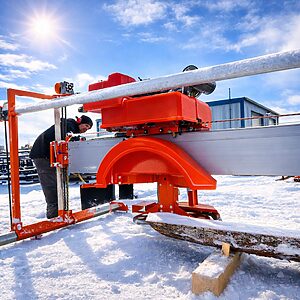
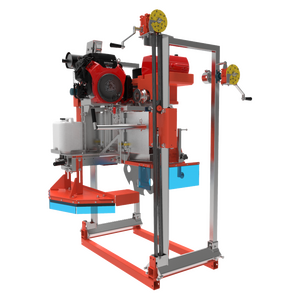
Turbosawmill takes a different approach. Instead of making the chainsaw bar and chain the primary cutting tool, a rigid circular blade swings between horizontal and vertical cutting positions. That difference changes the way dimensional timber, beams and mixed products are produced from the log.
WORKING HEIGHT
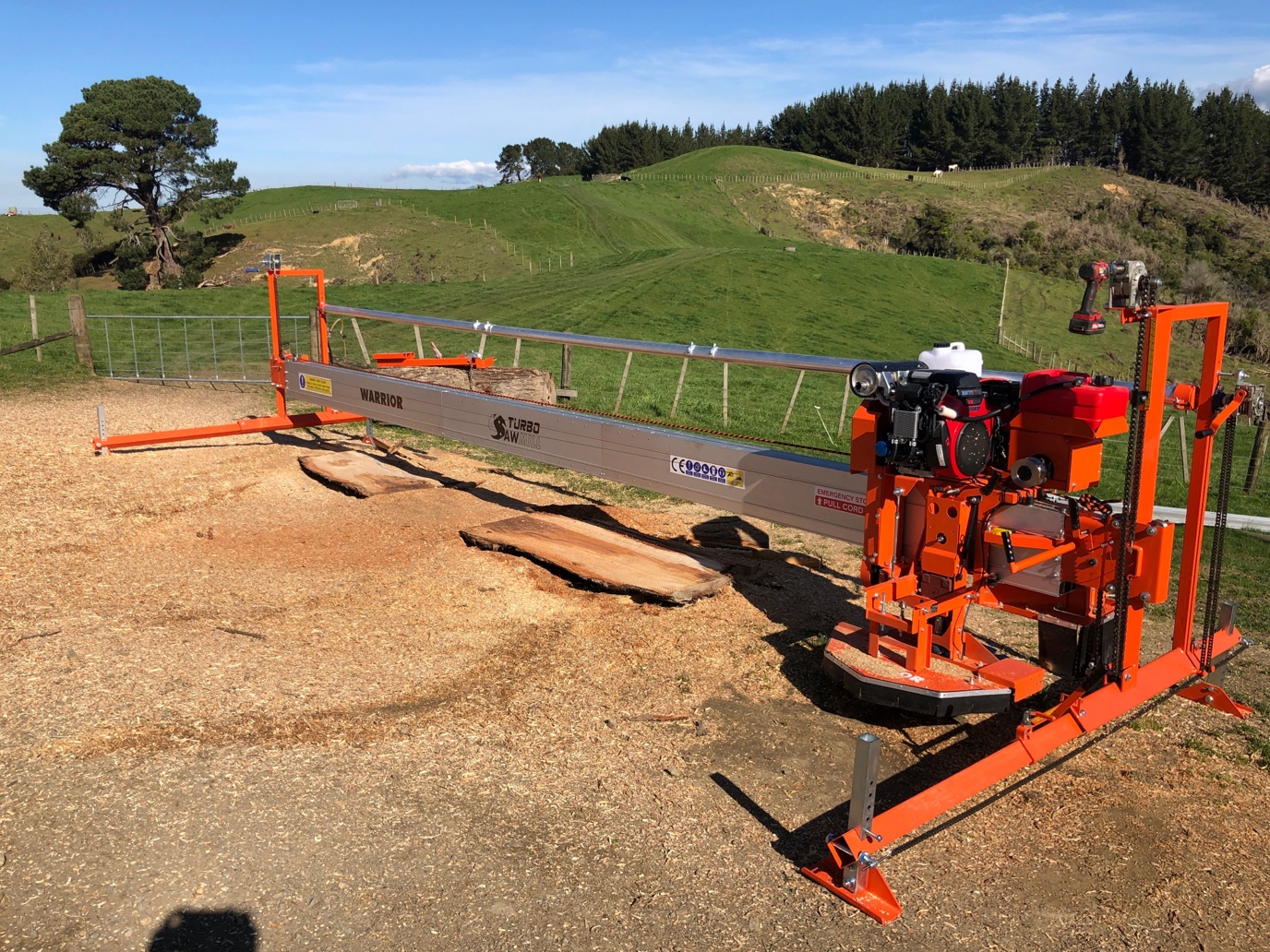
The cutting head is supported by the mill rather than carried across the log.
EDGED TIMBER
Horizontal and vertical cuts can produce finished dimensional boards directly.
OPEN ACCESS
Finished timber can move sideways out of the cutting area.
SLAB WHEN NEEDED
M10 and M12 can convert to a dedicated wide-slab attachment.
Chainsaw mills come in several forms
DIFFERENT DESIGNS. THE SAME IDEA OF MAKING A CHAINSAW DO MORE.
It is useful to separate a simple Alaskan-style mill from more developed chainsaw sawmills. All use a chainsaw or chain-sawing system, but the supporting structure and operator experience can be very different.
Granberg Alaskan Mill
The classic bar-mounted format. The mill clamps to the chainsaw bar and follows a straight reference for the first slab cut.
Visit GranbergNorwood PortaMill PM14
A rail-guided chainsaw sawmill that mounts the chainsaw on a carriage, with height adjustment and remote throttle control.
Visit NorwoodLogosol Chain Sawmills
A broad family of chainsaw-based sawmills including the F2, F2+, Timberjig and wide-slab systems using dedicated guide rails.
Visit LogosolTurbosawmill Swing-Blade
The chainsaw is not the primary cutting tool. A circular blade swings between two cutting planes to produce edged timber.
See the Turbosawmill designWhere a simple Alaskan-style mill makes sense
SIMPLE. PORTABLE. VERY GOOD AT MAKING WIDE SLABS.
A basic Alaskan-style mill is a remarkably compact way of sawing a log where it lies. The mill clamps directly to a chainsaw bar, and the bar and ripping chain travel through the log to create a slab.
For the first cut, a straight reference is normally fixed above the log. After that, the previously sawn surface becomes the guide. It is a practical approach for occasional live-edge slabs, remote logs and users who value minimum equipment and low setup cost.
If a full-width slab is already the finished product, that simple workflow can make a great deal of sense.
See Granberg’s Alaskan Mill rangeThe comparison changes when the finished product changes. Turbosawmill’s advantages become clearer when the job is repeated dimensional timber, beams, mixed board sizes or a combination of dimensional timber and occasional wide slabs.

Compare the complete milling process
THE ADVANTAGE IS IN WHAT HAPPENS BETWEEN THE CUTS.
A chainsaw mill and a swing-blade mill can both turn a log into valuable timber. Turbosawmill is designed around reducing the additional handling required when the final product is edged boards, posts and beams.
THE CHAIN MAKES THE RIP CUT.
Depending on the mill, the saw may be supported by a bar-mounted frame or a dedicated rail carriage.
- Excellent route to full-width slabs.
- Very portable options are available.
- Complete track systems can improve accuracy and operator position.
- The chain remains the primary cutting tool.
- Square-edged boards may require extra edging cuts or a second process.
THE BOARD IS EDGED AS IT IS PRODUCED.
One circular blade swings between horizontal and vertical positions while the log remains in place.
- Vertical and horizontal cuts produce dimensional faces directly.
- The mill frame supports and guides the cutting head.
- Finished boards leave through the open working side.
- Cutting sequence can change around the stationary log.
- M10 and M12 can swap to a separate wide-slab attachment.
| Workflow | Chainsaw / chain sawmill | Turbosawmill swing-blade |
|---|---|---|
| Primary cutting tool | Chainsaw bar and chain, or dedicated chain-sawing unit. | Rigid circular swing blade. |
| Guide structure | Ranges from a straight first-cut guide to a full rail carriage. | Single central beam with sizing built into the mill. |
| Natural product | Particularly well suited to slabs and flitches; rail systems can also produce boards. | Edged dimensional boards, posts and beams. |
| Board edging | Depends on the system and cutting sequence; slabs may need additional edging. | Horizontal and vertical cuts can edge the board during the primary milling process. |
| Wide slabs | A natural strength of large bar-and-chain slab mills. | M10 and M12 can use the bolt-on attachment slabber. |
| Operator position | Varies from direct bar-mounted operation to full standing-height rail systems. | The frame carries the carriage and cutting head at standing working height. |
| Portability | Ranges from extremely compact attachments to portable rail sawmills. | M7 emphasises portability; M10 and M12 add more structure and production capacity. |
| Typical Turbosawmill advantage | When the job is repeated dimensional timber, the swing-blade system combines sizing, edging and cutting on the same frame. | |
Support the cutting head with the mill
THE FRAME CARRIES THE MACHINE. YOU CONTROL THE CUT.
The simplest bar-mounted mills keep the operator close to the chainsaw powerhead as the saw moves across the log. More developed systems from Norwood and Logosol improve that experience by adding tracks, guide rails, height control and carriage support.
Turbosawmill begins with a guided carriage as the core of the machine. The beam carries the saw head, and the operator works from the frame rather than balancing or guiding the cutting assembly directly across the log.
On the manual M7 and M10, the operator still provides feed effort. On the M12, hydrostatic carriage feed moves the saw through the cut.
Forestry Forum: chainsaw milling experiences Forestry Forum: chainsaw-milling effort discussion
Where the swing-blade workflow stands out
MAKE THE BOARD — NOT JUST THE SLAB.
If your finished product is live-edge slabs, a chainsaw slab mill may already be doing exactly what you need. If your day is mainly dimensional boards, posts and beams, edging becomes a larger part of the total workflow.
A swing blade makes both cutting planes from the same carriage. Set the vertical dimension, make the vertical cut, swing the blade, then make the horizontal cut. The timber can leave the log already squared to the dimensions you selected.
01
Set the width
Position the vertical cut where the board edge needs to be.
02
Make the vertical cut
Create one dimensional face while the log remains in place.
03
Swing the blade
Change the circular blade through 90 degrees.
04
Release the timber
The horizontal pass completes the next face and frees the board.
Kerf is only one part of timber recovery. Product dimensions, edging, resawing, handling, log defects and cutting pattern all affect the amount of saleable timber recovered.
Chainsaw-mill maintenance
IN A CHAINSAW MILL, THE CHAIN IS PART OF THE MILLING SYSTEM.
Chain-based sawmills can produce excellent timber, but their performance naturally depends on chain sharpness, chain tension, bar condition and oil delivery because the chain itself is doing the timber cut.
The chainsaw-milling community spends a lot of time discussing ripping-chain geometry, sharpening, oiling and feed pressure. That is useful knowledge rather than a criticism of the method—it is simply part of operating a chain-cutting sawmill well.
Forestry Forum: ripping-chain discussionWant wide slabs as well?
KEEP THE SWING-BLADE MILL. BOLT ON THE SLABBER.
The M10 and M12 let you keep the dimensional-timber advantages of a swing blade while adding a separate slabbing system for wide live-edge work.
Remove the circular-blade cutting assembly and fit the Turbosawmill attachment slabber to the existing carriage. The current attachment uses a heavy-duty 72-inch bar and RX27 chain system and is designed for slabs up to approximately 5 ft (1.5 m) wide.
A remote hand-crank winch controls feed from the operator end. The existing sawmill frame carries and guides the slabber through the cut.
ONE FRAME. TWO TYPES OF CUTTING.
- Fits the existing Turbosawmill carriage.
- 72-inch heavy-duty bar.
- RX27 chain system.
- Up to approximately 5 ft / 1.5 m slab width.
- Remote hand-crank winch feed.
- Return to the circular swing blade for dimensional production.
The M7 PowerSaw distinction
CHAINSAW POWER. SWING-BLADE CUTTING.
The M7 PowerSaw uses a professional chainsaw as its power source, but it does not use the chainsaw bar and chain to make the timber cut. The chainsaw drives a Turbosawmill circular swing blade.
That gives users who like the portability and serviceability of a chainsaw engine another route into swing-blade milling: 7 × 7 in (178 × 178 mm) standard beams, double cutting to 14 in (356 mm), and a 14 ft (4.2 m) standard cutting length.
Turbosawmill options
CHOOSE THE LEVEL OF CAPACITY AND AUTOMATION YOU NEED.
Customers often move beyond a basic chainsaw mill because their product mix or workload changes. Turbosawmill offers three different starting points built around the same open-sided swing-blade concept.
Portable / Chainsaw-powered
M7 POWERSAW
Use a professional chainsaw to power a true circular swing blade. A portable entry into dimensional swing-blade milling.
Manual / 25 hp
M10-25M
Larger 10-inch swing blade, single-end sizing and an upgrade path from manual feed to powered feed and attachment slabbing.
Automated / Production
M12-35A
Hydrostatic carriage feed, automatic mechanical blade swing, 12-inch standard capacity and one-operator production.
See the other systems for yourself
COMPARE THE DIFFERENT APPROACHES.
We encourage customers to look at the other portable milling systems available. These links go directly to manufacturers and independent sawmill-owner discussions so you can see how different chainsaw-milling approaches work.
Granberg
Official Alaskan chainsaw mill range and bar-mounted milling systems.
Visit GranbergNorwood PortaMill
Official PM14 page showing Norwood’s rail-guided chainsaw sawmill.
Visit NorwoodLogosol
Official chain-sawmill range including F2, F2+ and wide-slab systems.
Visit LogosolForestry Forum
Independent sawmill-owner discussions about chainsaw milling, ripping chains, setup and real-world use.
Read Forestry Forum discussionsWhat do you want to produce?
CHOOSE THE MILL AROUND THE FINISHED TIMBER.
If you mainly want occasional wide slabs, a chainsaw slab mill may be exactly the right tool. If you want regular dimensional boards, beams, mixed cutting patterns and the option to slab when required, explore the Turbosawmill swing-blade range.
BUILD YOUR SAWMILL
Get ahead of the pack with a state of the art portable
SAWMILL
Tell us the timber you cut and where you cut it.
We will come back with the model, the track length and the delivered price.