

US 207-200-1920
February 21, 2024
◉ Steven Morris – M10-28A (showcase).
“A 65% Productivity Gain with One Operator”
Steven Morris – Tasmania, Australia
After seven years running a commercial timber milling business in Tasmania, Steven Morris has worked with almost every major portable sawmill system on the market.
He has owned and operated band mills, a Peterson ASM automatic swing-blade mill, five Lucas mills, and now runs a Turbosawmill Warrior Automated system as the core of his in-yard operation.
“I’ve operated mills with crews and as a one-man operation,” Steven explains. “That experience gives you a very clear view of what actually works in the real world.”
Today, Steven operates two Lucas mills for mobile jobs and a Turbosawmill Warrior Automated mill for stationary production.
Real-World Comparison of Sawmill Systems
Band Mills
Steven is direct about entry-level band mills.
“The cheaper band mills are difficult to keep accurate and require constant adjustment,” he says. “To achieve consistently good results, you need a significant investment. On top of that, band replacement costs add up quickly.”
Peterson ASM
The Peterson ASM, in Steven’s view, performs well when conditions are ideal—but complexity is its weakness.
“It feels like a portable mill that’s been added to repeatedly in order to become automated,” he explains. “The result is a machine that can feel flimsy and requires multiple adjustments if something is knocked out of alignment.”
He also notes the complexity of the electrical system.
“The sizing system relies on many small motors and wiring circuits. In my opinion, it’s not truly portable and is better suited to a boutique-style operation.”
Lucas Mill
Steven speaks highly of the Lucas system.
“The Lucas mill is hard to fault. It’s robust, versatile, and genuinely portable. I’ve done many thousands of hours on Lucas mills.”
The limitation, he says, is physical demand.
“It’s not automated, so maintaining high output requires a fit operator and sustained effort.”
Turbosawmill Warrior Automated
For Steven, the Turbosawmill stands apart in both design and productivity.
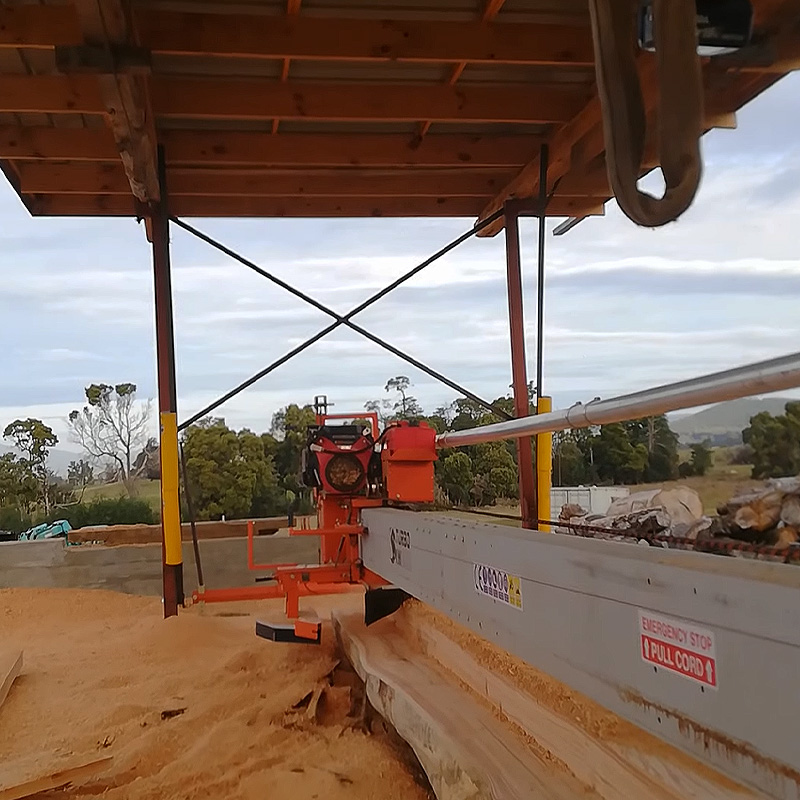
“The Turbosawmill is by far the easiest mill to load logs onto,” he says. “The single-rail design allows the beam to move out of the way of the bearers, which makes handling large logs much simpler.”
He also highlights the simplicity of the system.
“It’s a much simpler design than the Peterson, yet it delivers better accuracy, higher output, and easier operation.”
The result has been measurable.
“The Turbosawmill has increased our one-man production by approximately 65% compared to the Lucas.”
Because of its design, Steven uses the Turbosawmill primarily in a stationary yard setup, while retaining Lucas mills for mobile on-site jobs.
Beyond the Machine: System Efficiency
Steven emphasizes that productivity depends on more than the sawmill itself.
“Log handling, sawdust management, and site layout are just as important as the mill,” he says. “If the setup isn’t efficient, loading logs and cleaning up can take as long as the cutting itself.”
A Professional Verdict
For Steven Morris, the Turbosawmill has proven to be more than just an incremental upgrade—it represents a fundamental shift in productivity for small to mid-scale operations.
By combining automation, simplicity, and structural design, the Turbosawmill has delivered a rare outcome in portable milling:
significantly higher output with fewer physical demands and fewer operational complexities.
Contact Us
Message our team today, wherever you are in USA, and we’ll get right back to you.