

US 207-200-1920
February 21, 2024
◉ Canningvale – M12-25A (showcase).
“Proven Reliability in a Commercial Timber Environment”
Canning Vale Timbers Pty Ltd – Melbourne, Australia
John Mavros & Shannon Helmers
For John Mavros, returning to sawmilling was never part of the plan.
After decades operating large commercial sawmills, health issues forced him to scale back operations and sell most of his heavy machinery. He retained his land and buildings, continuing in the timber industry by sourcing and reselling timber to long-standing customers.
But market demand began to change.
Customers increasingly requested custom-sawn timber—special sizes, short runs, and unique cuts that were difficult and time-consuming to source externally. Lead times stretched, margins tightened, and flexibility became essential.
That was the turning point.
To regain control over production and offer bespoke timber efficiently, Canning Vale Timbers began evaluating portable sawmill options.
Choosing the Turbosawmill
In January 2019, Canning Vale Timbers purchased a Turbosawmill M12HD-25A after evaluating several competing systems, including Lucas Mill, Mahoe, and Peterson ASM.
The decision was driven by several key advantages:
12″ automated cutting capability
Open single-beam monorail design
Digital sizing (setworks) system
Commercial-grade build with compact footprint
“Having automation and an open-beam design in a 12-inch swing-blade mill was a major factor,” John explained.
Although delivery took several months, Turbosawmill founder Jake Peterson personally attended the site to provide training and commissioning.
One Operator, Commercial Output
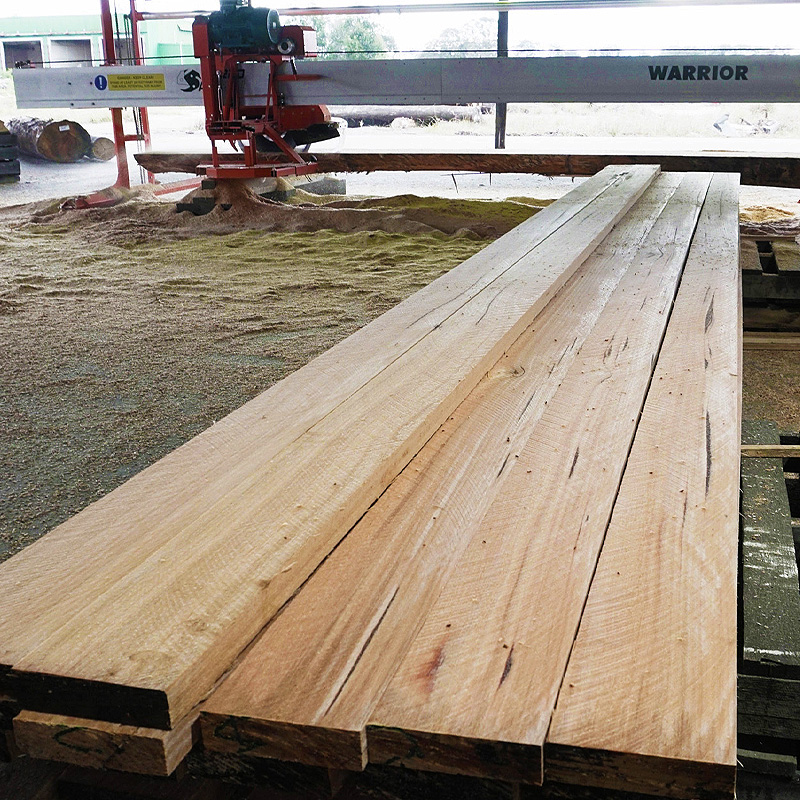
Today, the mill is operated by Shannon Helmers, a single-operator sawyer working independently within Canning Vale Timbers’ large industrial facility.
Despite the scale of the building—which once housed full commercial sawmill equipment—the Turbosawmill integrates seamlessly into daily operations.
Log handling is assisted by a forklift, while a secondary bench resaw processes bottom flitches.
Before milling, Shannon thoroughly cleans logs with a water blaster to remove dirt and stones.
“That extra step dramatically extends the life of carbide teeth,” he says.
“Water also keeps the blade cooler, which means smoother cuts and lower power demand.”
Daily maintenance is simple:
Cleaning beam rails
Lubricating chains and moving parts
General inspection
Production Performance
Shannon typically produces:
- 5 cubic meters per day (≈ 2,110 board feet)
- Peak days exceeding 8 cubic meters (≈ 3,376 board feet)
- After more than two years of operation:
- 2,100+ operating hours
- 520 cubic meters of timber produced (≈ 220,000 board feet)
- 2–3 cubic meters of sawdust per day, sold to local farmers
- Most production consists of farm timber sizes such as:
- 1×6
- 2×6
- 3×2
- plus specialized custom cuts
Built for Real-World Work
The M12HD-25A is one of the earliest Generation-2 heavy-duty Turbosawmill models, featuring:
18 kW (25 hp) three-phase electric motor
12″ circular swing-blade capacity
Automated feed system
Like any serious machine, the mill experienced some early development challenges—but these were addressed rapidly.
Key Improvements Implemented:
- Insert Tooth Stability
Early blades used industry-standard insert teeth, which occasionally vibrated forward—a known industry issue. - Turbosawmill responded by developing a new retention system.
Once upgraded, no further failures occurred. - This design is now standard across all Turbosawmill models.
- Roller Wear
Initial roller wear was higher than expected due to the heavy electric motor load. - Design improvements extended roller life significantly.
Turbosawmill now offers brass rollers for enhanced durability. - Gearbox Input Shaft Replacement
At approximately 1,000 hours, an input shaft required replacement.
Downtime: 5 hours.
Operating Costs: A Commercial Reality Check
Over 2,100 hours of operation, recorded maintenance costs were remarkably low:
22 wear rollers – $220
38 carbide teeth – $432
12 belts – $720
Gearbox shaft & spare gearbox – $625
4 drive ropes – $120
Total maintenance cost: $2,117
Cost per cubic meter: ≈ $4
(excluding electricity and overheads)
For commercial timber production, this is exceptional.
Capability Beyond Conventional Limits
Shannon highlights the mill’s versatility:
“Recently we cut a 4-foot-diameter grey gum log and produced around 4 cubic metres of timber.
Many machines simply can’t do that.”
Feature Insights from the Operator
✓ Open Single-Beam Design
“The open side makes loading, unloading, and cleanup extremely easy. Accessibility is a huge advantage.”
✓ Insert Blade Technology
“On-site maintenance is simple. We don’t need welding or specialist blade servicing.”
✓ Digital Sizing System
“Extremely accurate and reliable. We’ve had zero issues.
It’s simple, safe, and professional.”
“Your vehicle has more electronics than this mill.
The system is straightforward and proven.”
A Mill That Earned Its Place
Both John Mavros and Shannon Helmers are unequivocal in their assessment:
“It’s proven to be very reliable.”
For Canning Vale Timbers, the Turbosawmill has not only restored in-house milling capability—it has transformed their ability to respond to customer demand with speed, precision, and flexibility.
In a commercial environment where downtime, complexity, and costs matter, the Turbosawmill has demonstrated what modern swing-blade technology can deliver.
Contact Us
Message our team today, wherever you are in USA, and we’ll get right back to you.