

US 207-200-1920

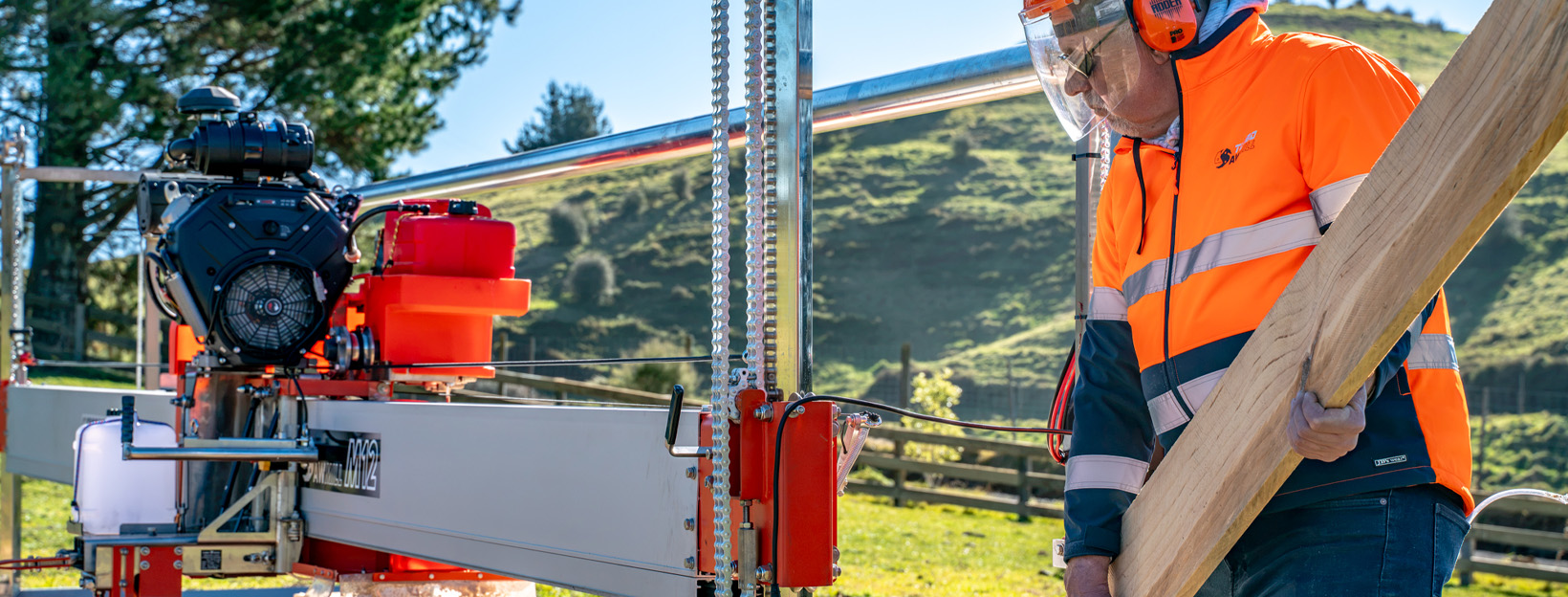
Turning Logs Into a Highly Profitable Business
Understanding the Numbers
For decades, portable sawmills have given owners the ability to convert low-value logs into high-value timber. What sets the TurboSawmill M12-35A apart is not simply its production capacity, but its exceptionally low operating costs, allowing a much greater proportion of every sale to remain as gross profit.
The figures presented in this guide are based on a commercial production model designed to demonstrate what is achievable when the machine is operated efficiently. They assume access to large-diameter, premium-quality softwood logs approximately 20 feet (6 metres) in length, consistent production throughout the working year, and an established market capable of purchasing the timber produced.
As with any manufacturing business, real-world results will vary. Log quality, timber species, operator experience, local market conditions, downtime, weather, maintenance, labour efficiency, and sales capability all influence profitability. Not every operator will achieve these production levels immediately, nor will every business be able to sell every board produced.
However, these figures are not based on unrealistic theory. They demonstrate the commercial potential of an efficient sawmilling operation when the essential ingredients are in place: quality logs, an efficient workflow, disciplined operation, and a strong sales network.
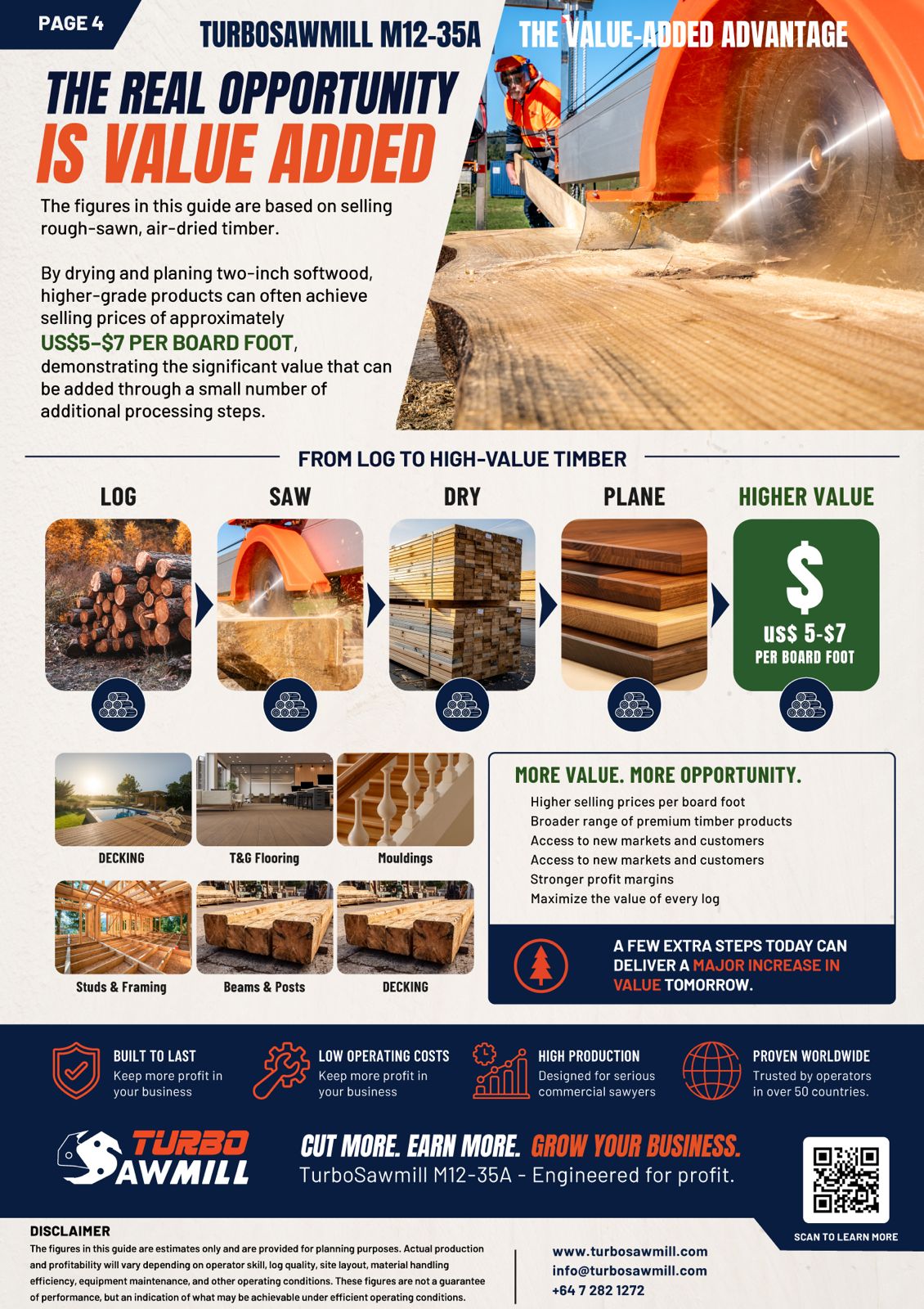
Perhaps the most important takeaway is not the headline revenue figure, but the underlying economics. Every improvement in log quality, recovery, production efficiency, and value-added processing compounds profitability. Operators who dry, machine, or further process their timber can often increase returns well beyond those achieved from selling rough-sawn boards alone.
The TurboSawmill M12-35A has been engineered to provide professional operators with a reliable, low-maintenance platform capable of commercial-scale production. For businesses with access to timber and established customers, it represents an opportunity to build a profitable and sustainable enterprise from one of the world's most renewable resources.
The figures in this guide should therefore be viewed as a commercial planning benchmark—illustrating the level of performance that can be achieved under favourable operating conditions—rather than as a guarantee of individual financial results. When combined with sound business management, quality raw material, and strong market demand, the TurboSawmill M12-35A has the potential to become the foundation of a highly successful timber business.
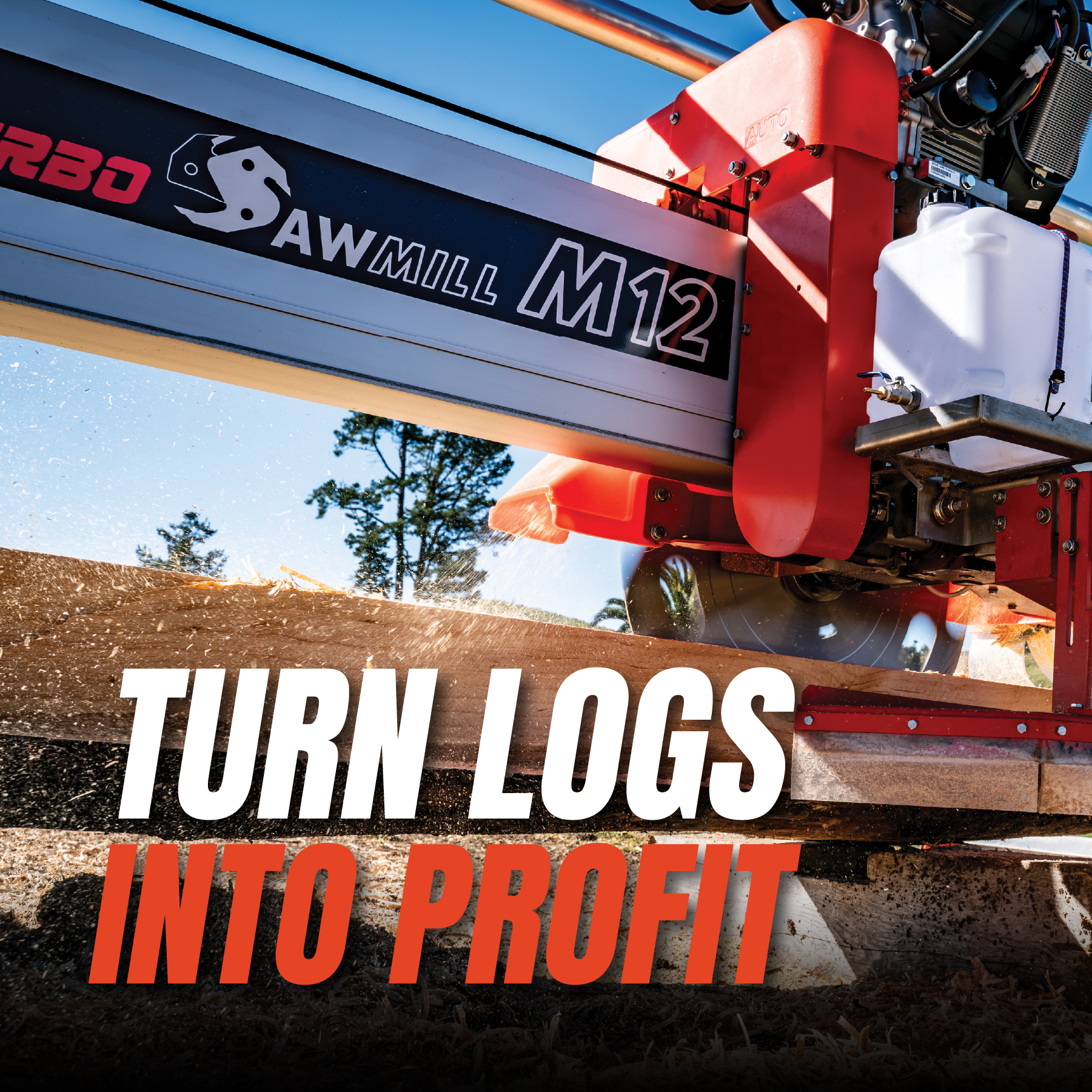
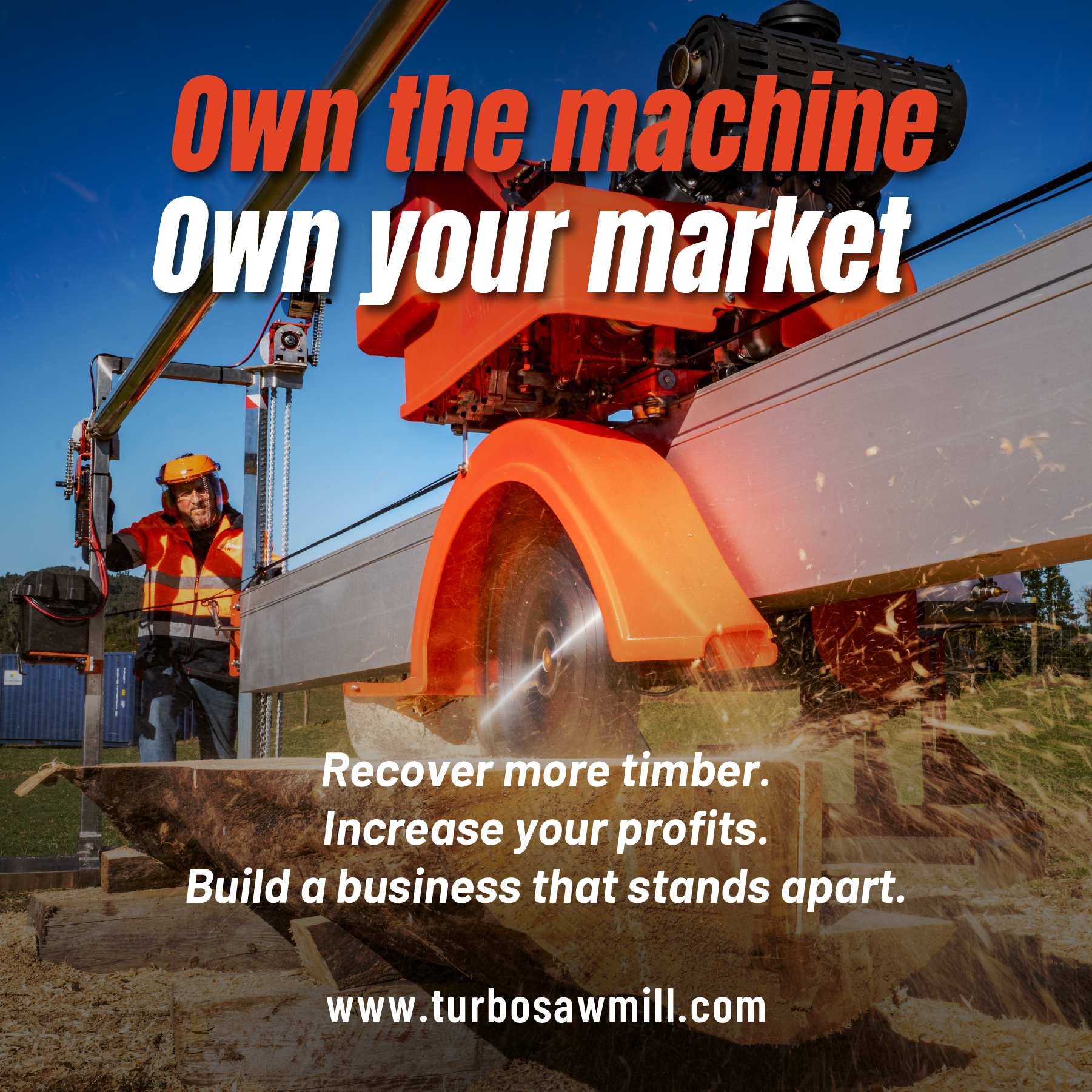
Why Professionals Choose TurboSawmill
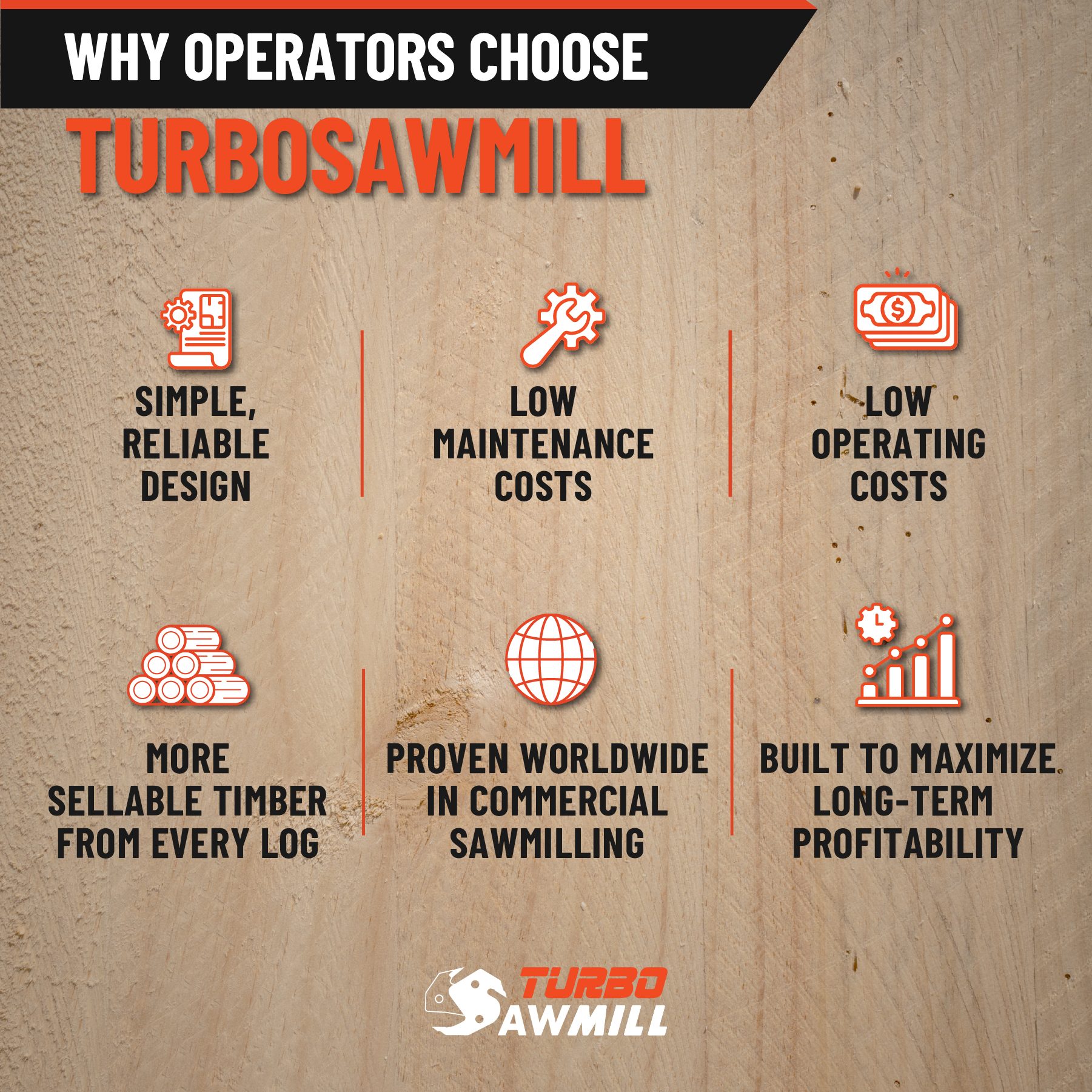
A commercial sawmill is more than just its cutting speed—it is measured by the value it delivers over years of operation. The TurboSawmill M12-35A has been engineered to maximize profitability through a combination of simple, reliable engineering, low operating costs, and outstanding timber recovery.
Its straightforward mechanical design minimizes maintenance and reduces downtime, while low consumable and servicing costs help keep more money in your business. The unique swing-blade system is designed to recover more sellable timber from every log, increasing the value extracted from your raw material.
Trusted by commercial operators in more than 50 countries, TurboSawmill has earned a reputation for dependable performance in demanding conditions. Every aspect of the machine has been developed with one goal in mind: delivering reliable production today while maximizing long-term profitability for years to come.
Commercial Performance at a Glance
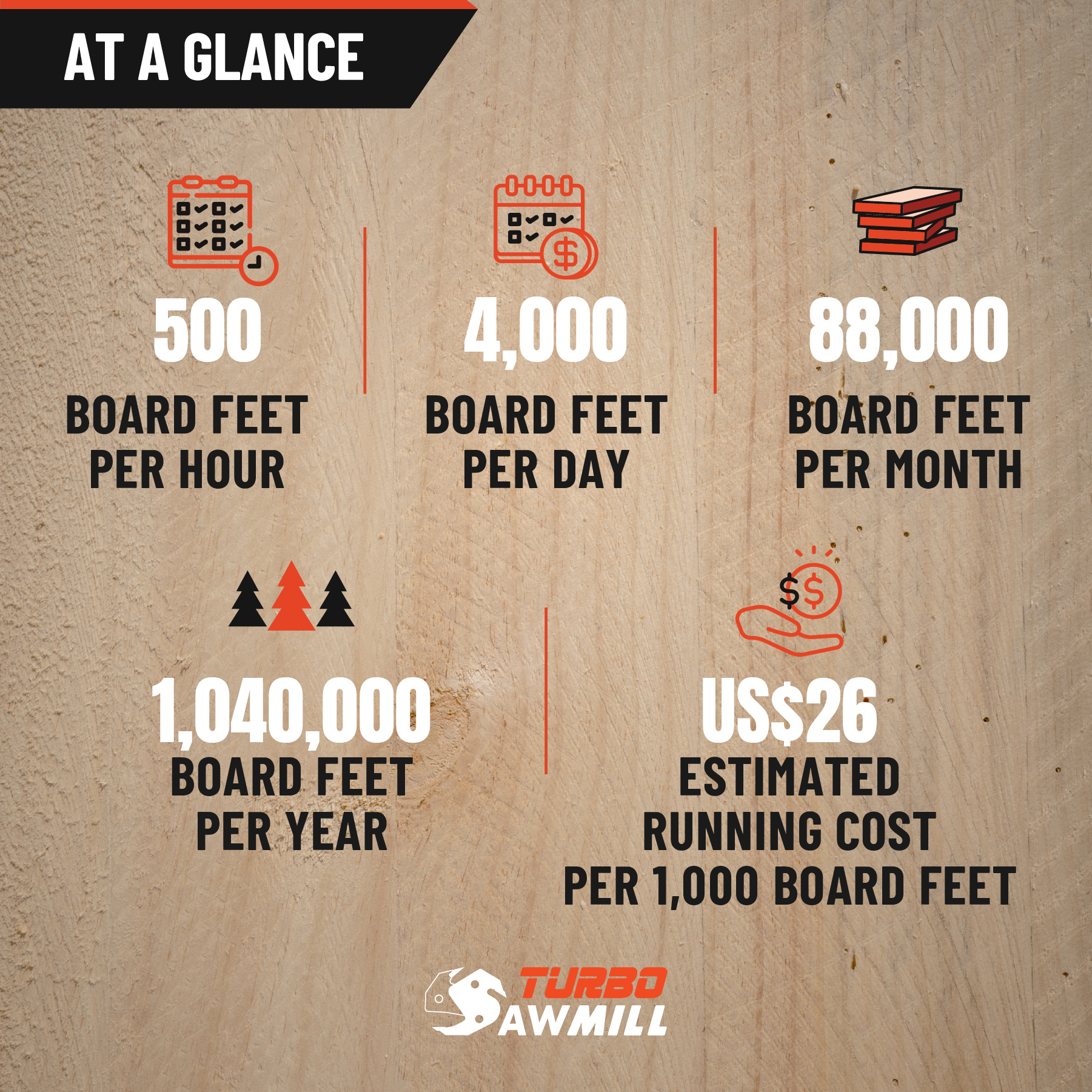
The figures shown provide a practical snapshot of the TurboSawmill M12-35A's commercial production potential. To ensure the projections remain realistic, we've deliberately based our planning model on a conservative production rate of 500 board feet per hour, even though the machine is capable of producing up to 1,000 board feet per hour under ideal conditions. This built-in buffer allows for normal production interruptions such as log handling, blade changes, operator breaks, varying log quality, and general workflow inefficiencies.
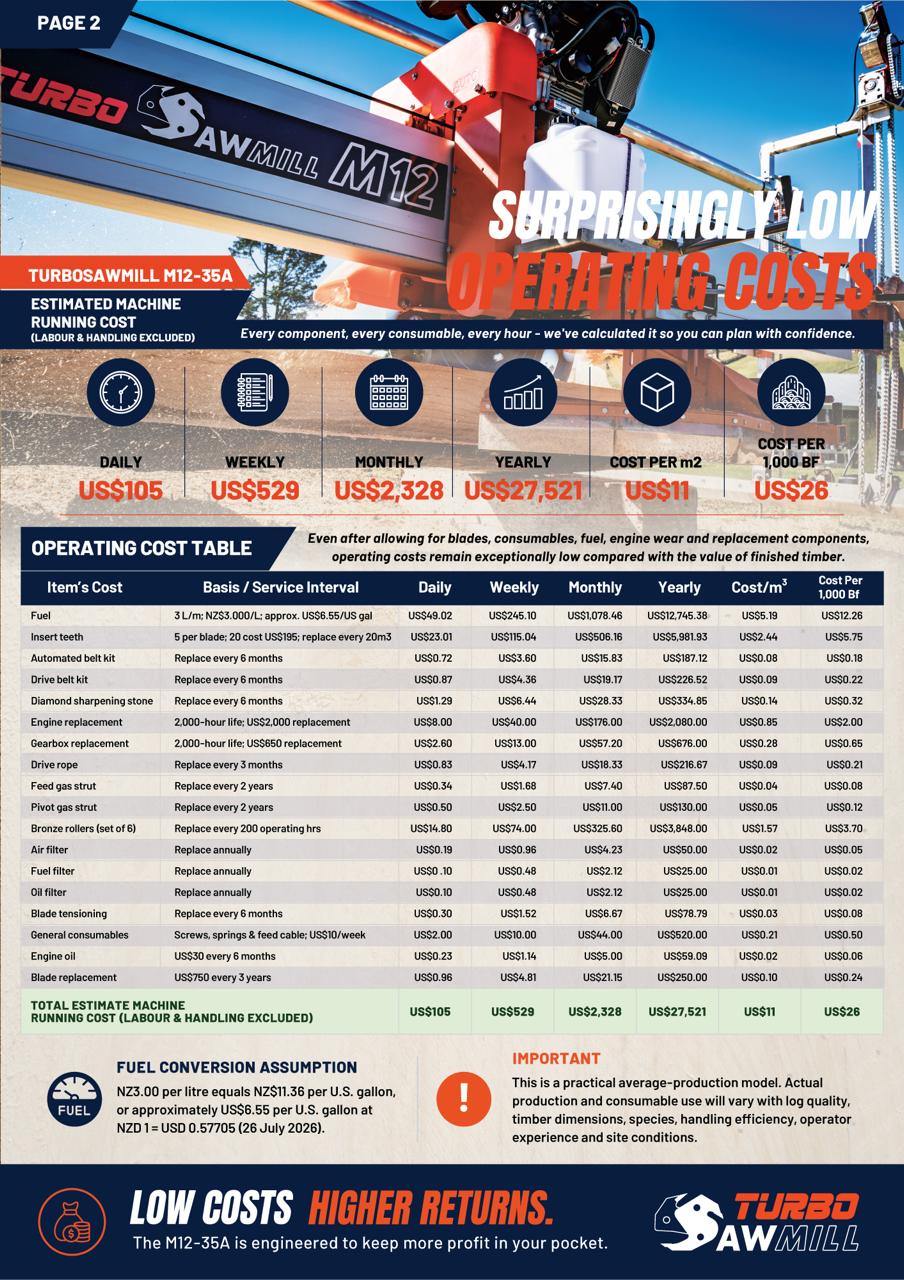
The same conservative approach has been applied to operating costs. Fuel has been valued at approximately US$6.55 per U.S. gallon, a price higher than many operators pay, providing additional allowance within the model. These conservative assumptions are intended to absorb the realities of day-to-day commercial sawmilling rather than present overly optimistic figures.
The result is a planning model that demonstrates not only the M12-35A's impressive production capability but also its exceptionally low operating costs. Under favourable conditions, experienced operators may exceed these production assumptions and achieve even greater efficiency and profitability.
From Raw Logs to Real Profit
Every successful timber business begins with a log, but the real value lies in what that log becomes. The TurboSawmill M12-35A is designed to efficiently convert low-cost raw material into high-value timber, giving operators the opportunity to build a profitable manufacturing business rather than simply processing wood.
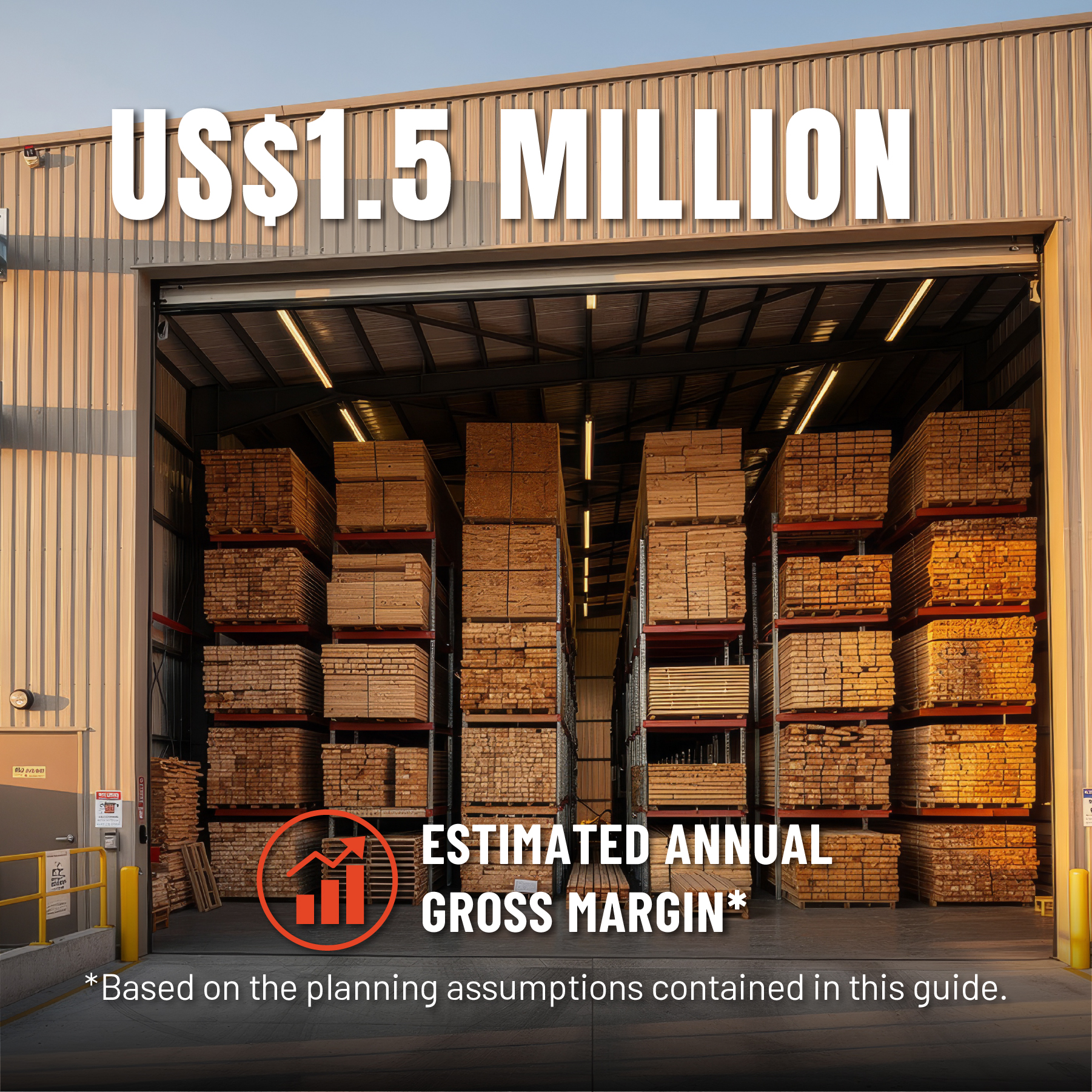
The production model presented in this guide demonstrates the commercial potential of a well-managed operation. Under favourable conditions, with premium logs, efficient production, and the ability to market the finished timber, the M12-35A has the potential to generate an illustrative annual gross margin exceeding US$1.5 million. These figures are based on the planning assumptions outlined throughout this guide and represent a best-case commercial benchmark rather than a guaranteed financial outcome.
The key message is simple: the greatest opportunity is not just milling logs—it's transforming them into products that command significantly higher value. With efficient recovery, low operating costs, and strong market demand, the TurboSawmill becomes the foundation of a business capable of converting raw timber into long-term profitability.
Big Mill Capacity. Small Mill Overhead.
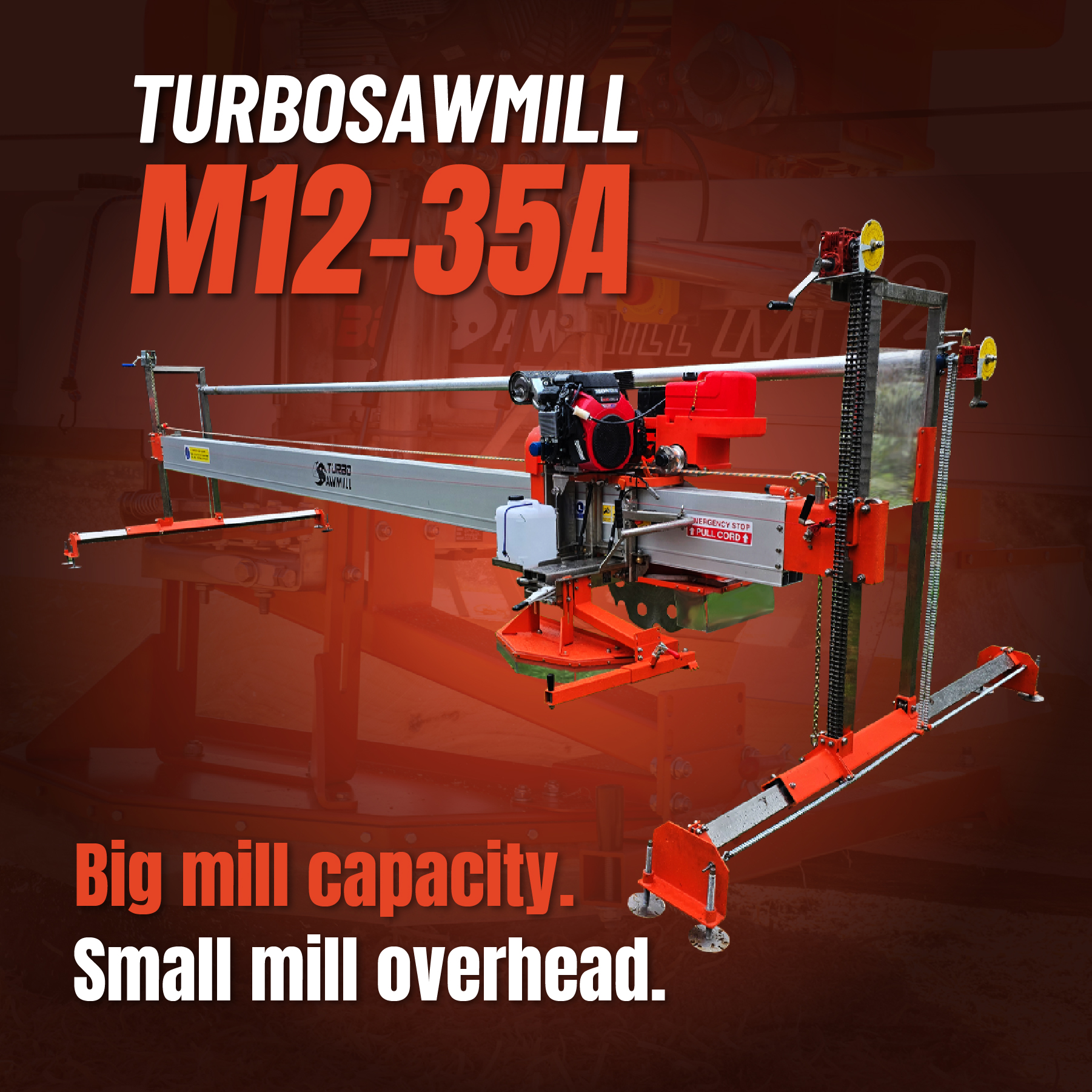
The TurboSawmill M12-35A has been engineered to bridge the gap between small portable sawmills and large industrial operations. It delivers the production capacity required for serious commercial sawmilling while avoiding the high capital investment, complex infrastructure, and ongoing overheads typically associated with conventional mill systems.
Its simple mechanical design keeps maintenance requirements low, reduces downtime, and minimizes operating costs, allowing more of every timber sale to contribute directly to your bottom line. Combined with outstanding timber recovery, efficient fuel consumption, and straightforward operation, the M12-35A provides a practical pathway for businesses looking to achieve commercial-scale production without commercial-scale overhead.
Whether you're expanding an existing timber operation or building a sawmilling business from the ground up, the M12-35A is designed to maximize productivity, minimize running costs, and deliver strong long-term returns from every log processed.
The Economics of Efficient Sawmilling
The success of any commercial sawmill depends not only on production, but on the cost of producing every board foot. The TurboSawmill M12-35A has been engineered to deliver commercial production with exceptionally low operating costs.
Our operating cost model includes fuel, insert teeth, bearings, belts, filters, lubricants, and routine maintenance, providing a realistic picture of day-to-day running expenses. To keep the figures conservative, we've based our calculations on US$6.55 per gallon fuel and a production rate of 500 board feet per hour, allowing for normal interruptions such as log handling, blade changes, and maintenance.
Even with these conservative assumptions, estimated machine running costs remain approximately US$26 per 1,000 board feet (excluding labour and material handling). Combined with its simple, reliable design and low maintenance requirements, the M12-35A provides a practical platform for building a profitable commercial sawmilling business.
For a detailed breakdown of the assumptions and operating cost calculations, click the link below.
Small Changes. Big Gains.
One of the biggest contributors to profitability isn't just how fast you can cut—it's how efficiently you handle your logs and timber. A well-organised yard can significantly increase daily production while reducing labour and unnecessary machine movement.
If you have the space, consider laying out several days' worth of logs in a straight line. By fitting wheels to the base or using longer skids, the sawmill can simply be rolled or winched from one log to the next, dramatically reducing setup time. For many operators, this simple change alone can noticeably improve productivity.
The most efficient solution, however, is an all-terrain forklift or compact loader. It becomes the workhorse of the operation—loading logs onto the bunks, removing finished timber, stacking boards, managing offcuts, and keeping the worksite organised. Timber can be stacked directly into drying packs, while slabwood and offcuts are bundled for sale as firewood or biomass. Sawdust can be progressively cleared, maintaining a clean, safe, and efficient workspace.
A successful sawmilling business is built on more than a great sawmill. It's the combination of smart workflow, efficient material handling, and good site organisation that allows operators to maximise production and profitability. Pair the TurboSawmill M12-35A with an all-terrain forklift, and you have a highly efficient system capable of delivering commercial-scale results with remarkably low overheads.